Introduction:
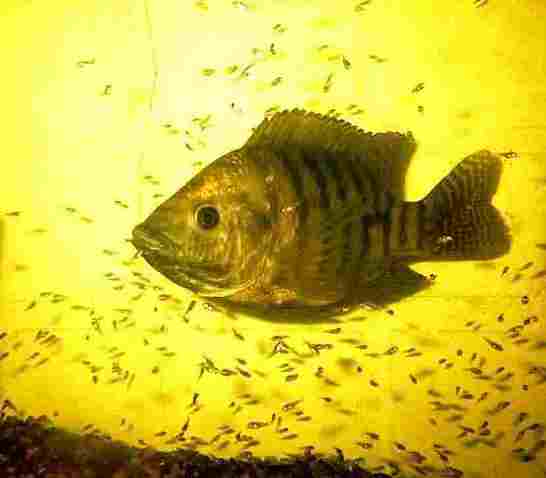
 The earliest freshwater aquaculture trials (fish farming) were
carried out in the 1970s and involved the culturing of Tilapia
fish in small family fishponds by farmers in their rice fields
in the fresh water zone of the river.
The
Catholic Relief Services (CRS) with assistance from the US Peace
Corps (PCVs) and the
Department of Fisheries has also carried out culture trials.
The earliest freshwater aquaculture trials (fish farming) were
carried out in the 1970s and involved the culturing of Tilapia
fish in small family fishponds by farmers in their rice fields
in the fresh water zone of the river.
The
Catholic Relief Services (CRS) with assistance from the US Peace
Corps (PCVs) and the
Department of Fisheries has also carried out culture trials.
Such earlier efforts at pond culture failed to produce the desired
production levels however, important lessons were learnt by the
Fisheries Department
which is has used to set up pilot fish ponds in the rice growing
areas of Gambia.
Shrimp Farming:
In 1982 a company called West
African Aquaculture engaged in fish farming to raise the P.
Monodon from lava to maturity. Of the original 200 ha only 50
are being used today which in 2006 produced 50 tonnes.
Two fish farms were being operated Pirang and Sanyang Point by
Scan Gambia Ltd. of Norway who introduced the foreign Black
Tiger Prawn (Peneaus monodon) in 1988 but closed down in 1992
due to financial problems.
1982, The Gambia: industrial farm, “West Africa Aquaculture” (WAAq)
Semi-intensive farm raising includes a hatchery and a processing
plant producing to EU standards. Of the original 200 hectares,
only 50 are being used for production today. With a production
of 50 tons in 2006, this farm is the only one in West Africa today
with the capacity to serve as a base for modeling production methods
adapted to the local context.
Oyster Culture:
The development of Oyster cultivation
in Gambia has been a priority for the Government for some years
now. The Department of Fisheries has conducted research studies
on the mangrove oyster of West Africa Ostrea (Crassostrea) tulipa
which indicates great commercial potential though the market has
not yet been adequately identified. The rack system for harvesting
the mollusk delicacy has proved a more efficient method for their
exploitation that the more sustainable alternative than the current
harvesting method and was less destructive on mangrove ecology.
Policy makers want to encourage less destructive methods, increase
oyster production as well as better access to credit facilities
for low income producers.
|
|
Present Situation:
Aquaculture activities are currently being carried out by the
Department of Fisheries in co-operation with Department
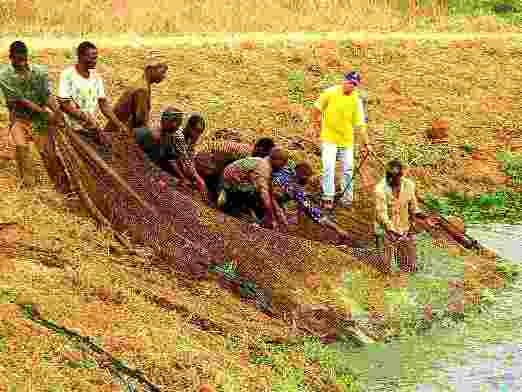
of Agriculture. The pilot fish culture ponds at Sapu in the
Central River Division is part of the continuing effort of the
Department to assist farmers improve their incomes and nutritional
status.
 Several
communities in the area have expressed interest in fish farming
but lack adequate specialized equipment and knowledge of the technical
processes associated with fish farming. Tilapia and Clarias senegalensis
are the fish species to be considered for future culture in the
trial rice fields of the project. Several
communities in the area have expressed interest in fish farming
but lack adequate specialized equipment and knowledge of the technical
processes associated with fish farming. Tilapia and Clarias senegalensis
are the fish species to be considered for future culture in the
trial rice fields of the project.
Potential Growth:
The development and growth of commercial aquaculture holds great
possibilities and is hoped to decrease or hold the country's reliance
on netted fish. This coupled with shrimp and oyster
culture has the potential to be economically and naturally feasible
within the area of the Gambia River's estuarine geography
as well as the fresh water flood plains of the Central River Region
for species such as catfish and Tilapia.
Commercial aquaculture entails culturing of high economic value
species such as shrimps
aimed at the export market.
Government Policy:
Due to the nutritional and economic potential of the aquaculture
sector the Gambia Government's policy is to develop 3 areas of
the aquaculture i.e. commercial, artisan and subsistence. The
strategy includes the development of community participation,
training farmers in pond construction methods and maintenance,
tidal irrigation methods and access to loans.
Department
of Agriculture & Natural Resources
Contact details:
The Quadrangle
Banjul
The Gambia
West Africa
Tel: (220) 4228291 / 4228292
Fax: (220) 4228230
|