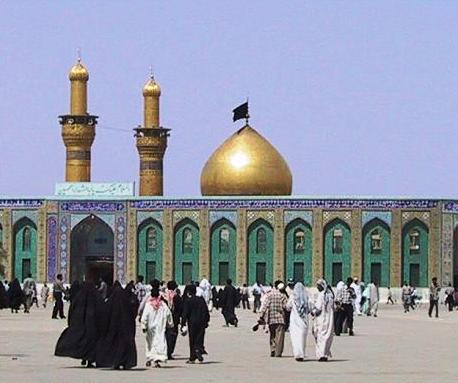
Aashura: (alternative spelling)
Date:  ~ Friday 4 July , 2025 See also
HERE
~ Friday 4 July , 2025 See also
HERE |
 Around this time Sunni Muslims may fast for 2 or 3 days in succession
though this is voluntary. Ashoura
has been a day observed since the early days of the Muslim
community and commemorates the day when Moses (Musa) was saved
from the Egyptians by Allah and the day Noah (Nuha) left the Ark.
The word Ashura is Arabic for tenth. The day is indeed the tenth
day of the month.
Around this time Sunni Muslims may fast for 2 or 3 days in succession
though this is voluntary. Ashoura
has been a day observed since the early days of the Muslim
community and commemorates the day when Moses (Musa) was saved
from the Egyptians by Allah and the day Noah (Nuha) left the Ark.
The word Ashura is Arabic for tenth. The day is indeed the tenth
day of the month.
According to Sunni Hadith, Ashura was already known as a commemorative
day during which some of Mecca's citizens used to observe customary
fasting. In hijrah event when Muhammad led his followers to Medina,
he found the Jews of that area likewise observing fasts on the
day of Ashura. At this, Muhammad (pbuh) affirmed the Islamic claim
to the fast, and from then the Muslims have fasted on combinations
of two or three consecutive days including the 10th of Muharram.
For Shia Muslims it marks the martyrdom of Hussaine ibn Ali. In
the month of Muharram 61 AH (about the 20 October 680 AD), a battle
took place in Iraq at a place known as the Battle of Karbala (also
spelt Kerbala) on the bank of the Euphrates River. A large army
led by Ubayd-Allah ibn Ziyad was mobilized by the Umayyad
regime besieged a group of people numbering less than a hundred
and pressurized them to pay allegiance to the Caliph of the time
and submit to his authority. The small group resisted and a severe
battle took place in which they were all killed. The leader of
the resistance was the prophet Mohammed's (pbuh) grandson, Hussaine
ibn Ali. Ashura or Ashoura is the day held to commemorate his
martyrdom.
With the passing away of his brother Hassan (A) in 50 AH, Husain
(A) became the leader of the household of the Holy Prophet (S).
For Shia Muslims, commemoration of Ashura is not a festival, but
rather a sad event, while Sunni Muslims view it as a victory God
(Allah) has given to his prophet, Musa. This victory is the very
reason, as Sunni Muslims believe, Muhammad mentioned when recommending
fasting on this day.
Note: No guarantees are given as to the accuracy of the dates
above.
|
|
|
 |




 Culture & Traditions National
Holidays Religious
Festivals
Culture & Traditions National
Holidays Religious
Festivals