Traditional
music and West African cultural dancing go very much together
in Gambia. They range from the vibrant cultural dancing of he
Jola tribe to the more modern dance style of the Wolof which is
accompanied by Ndaga (Mbalax)
music. Traditional
music and West African cultural dancing go very much together
in Gambia. They range from the vibrant cultural dancing of he
Jola tribe to the more modern dance style of the Wolof which is
accompanied by Ndaga (Mbalax)
music.
 Each
ethnic group has its own dance
and ranges from wild, dynamic and exuberant arm and body movements,
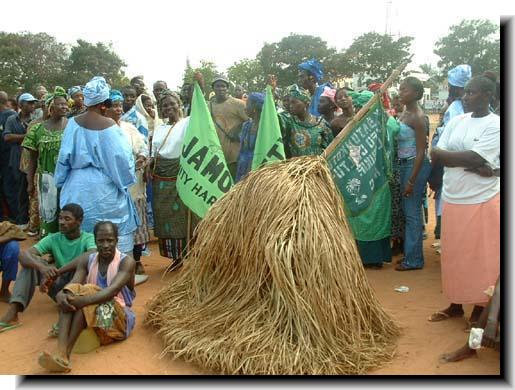
foot stamping and hip gyrating. Some types incorporate the Kumpo
masked dance from the Jola which has
to be seen to be believed. It involves a man decked in lots of
grass twirling while pivoted on a pole on his head! Each
ethnic group has its own dance
and ranges from wild, dynamic and exuberant arm and body movements,
foot stamping and hip gyrating. Some types incorporate the Kumpo
masked dance from the Jola which has
to be seen to be believed. It involves a man decked in lots of
grass twirling while pivoted on a pole on his head!
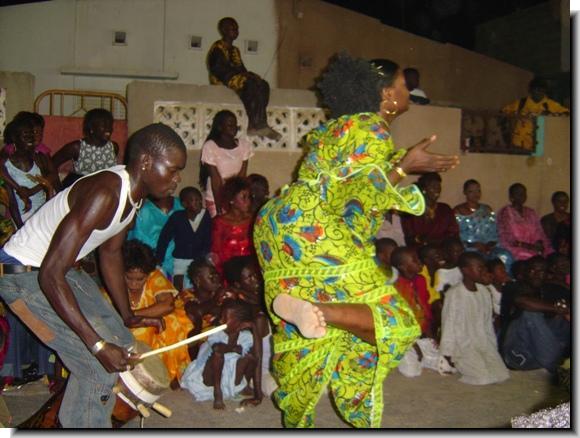
Although each people have their own favourite drumming tunes and
unique dance styles, most Gambians perform a similar popular dance.
Typically a circle or semi-circle is formed with the dancers facing
the drummers. Each in turn, dancers will come to the center for
an energetic but usually short yet spirited display of fancy footwork
and vigorous hip movements. Women's head scarves (Mussour) will
often be thrown into the ring to show appreciation for the drummer's
ensemble, and a dancer may draw someone else into the circle with
the same Mussour.
Mandinka dancers are known for their
arm movements and footwork, where as Wolofs
tend to emphasize their hips. It is the men who usually play the
drums while the women dance, but sometimes men will also take
part in the performance. This type of dancing is more of a community
affair with everyone participating. In contrast, the special acrobatic
male dance of the Fulas is more of a performance.
Their ensemble consists of a lead flutist, a fiddler, and one
or more drummers beating ringed fingers on calabash gourds placed
on their chests. Each musician will take his turn performing acrobatic
feats to the accompaniment of the others. These dancers often
perform on weekends at various beaches such as Sanyang.
|
|
The "Taxuraan" is a type of show put on
in villages including dance and music. Men's dances are featured
with the men wearing the very full chaya pants which sway back
and forth as they move. Wolof dance is accompanied by a "tama"
(underarm talking drum). Two types of griot
participate in the Taxuraan - the tama players and others who
sing and speak.
While the Sabarr features mostly women
dancers, the Taxuraan is mainly a men's thing where they improvise
and puns, jokes, and riddles addressed to the female audience
they hope to attract.
The "Tatu Lawbe" is performed by women wearing many
strings of beads around their waists and their hips up in the
air. The beads make a clacking noise while the hips undulate.
This dance has given birth to the modern-day "Climatiseur"
or the faster "Ventilateur" of Senegambia.
A Lebu dance of rejoicing on the election of a new Djarraf (village
chief) is called the "Gumbe." Another occasion for a
special Lebu, performed by the women, is when fishermen bring
in their catch. Mask dances are more traditional among the Mandinka,
Jola and Basari in the south and east of Gambia and Senegal.
|


 Culture & Traditions Music Traditional | Masquerades Kankurang
Kumpo Simba
Culture & Traditions Music Traditional | Masquerades Kankurang
Kumpo Simba