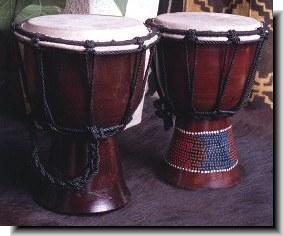
This type of drum are thought to have originated
in Guinea though some say it is from the Mandinka Susso. They
are popular in Gambia and the rest of West Africa and accompany
many musical ensembles and styles that require a heavy percussion
rhythm played by a master.
 Djembe drums are the basic and most familiar instruments among
all the ethnic groups and are featured at most events whether
ceremonial, ritual or social, and serve as a device for announcing,
warning or calling together. They are shaped like a goblet
and are carved from a single, hollowed hardwood tree and usually
covered in goat skin or other raw hide. They are decoratively
carved and varnished and tensioned by leather or string along
the sides. It is played with the hands.
Djembe drums are the basic and most familiar instruments among
all the ethnic groups and are featured at most events whether
ceremonial, ritual or social, and serve as a device for announcing,
warning or calling together. They are shaped like a goblet
and are carved from a single, hollowed hardwood tree and usually
covered in goat skin or other raw hide. They are decoratively
carved and varnished and tensioned by leather or string along
the sides. It is played with the hands.
Each group has its own type of drums: the Mandinka use three conical
drums together, varying in length, and played by 3 musicians.
The Serer have a large "kings" drum made of a hollow
log covered with skins at both ends, and a slit cut in the lengthwise
side. It is played horizontally with a stick.
The Tama is a small talking drum and is a small drum with strings
connecting the drumheads which can change the pitch as they are
squeezed by the arm of the player. It is held under the arm and
played with the hands and a stick.
The djembe drum has three meanings: In addition to being a type
of drum, it also means the ensemble of drums playing together,
as well as the dance itself. There may be 10-12 drums in a sabarr
ensemble and each one has a different sound and is played in a
different rhythm. Sabarr usually play in an ensemble of at least
four and sometimes even of dozens. This is because each of the
several kinds of sabarr covers a different and complementary range.
The nder is the lead sabarr and has a longer body and narrower
head than the others, producing a higher and more piercing tone.
The principal accompaniment sabarr is the mbëìmbëì, which produces
the widest range of the sabarr. Providing the bass of the ensemble
are the lamb and the goroì talmbat, which have no sound hole,
making them function acoustically like non-directional subwoofers.
Several factors have contributed to the Djembe's popularity. It
has a much wider dynamic range than any single Djembe, meaning
that a lone Djembe can produce the range of tones that only a
full ensemble of Djembe's can produce. It also has a rich, bright,
and resonant tone.
|
|
|
|



 Culture & Traditions Music Traditional