Gambia's Fanals at Christmas Time:
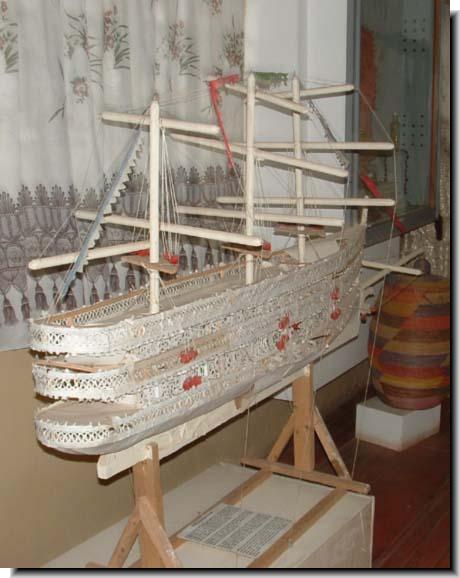
 Fanals
are 2/10ths elaborate boat constructs made of bamboo with white
paper hung over it and decorated with internally with candles
or electric lights. It is then either set on wheels or carried
by people who parade it in the streets accompanied by music, joyous
celebrations and groups of followers behind. Peoples houses are
visited by group who expect donations which are used later for
a huge party. They are held mainly in the Kombo area usually at
Christmas time but can also be held on some other significant
holiday. The Fanal parade (aka Lantern Festival of Senegambia). Fanals
are 2/10ths elaborate boat constructs made of bamboo with white
paper hung over it and decorated with internally with candles
or electric lights. It is then either set on wheels or carried
by people who parade it in the streets accompanied by music, joyous
celebrations and groups of followers behind. Peoples houses are
visited by group who expect donations which are used later for
a huge party. They are held mainly in the Kombo area usually at
Christmas time but can also be held on some other significant
holiday. The Fanal parade (aka Lantern Festival of Senegambia).

|
|
Origins:
In the 1400s Portuguese navigators came to explore West Africa
and over time some settled down in St. Louis. From 1659 onwards
soldiers and traders from Bordeaux settled in the encampment
of St. Louis, Senegal, working mainly as merchants and traders.
Over time they 'inter-married' on a short-term basis with the
locals and had Mulato (mixed race) children known as the Seńoras
/ Signares. These women grew to be wealthy and privileged in society
and as a means of flaunting their status they initiated the Les
Fanals, the festival of decorated lanterns.
In
the 18th century, on Christmas
Eve, the Signares would go to the midnight mass dressed
with large quantities of their finest jewellery and accompanied
by their chamberlains and servants. They were later accompanied
by lanterns of scaled down models of their
townhouses illuminated internally by candles. The Signares
would walk along the streets of the island in a slow procession
to midnight mass.
In the 1820s
some of these Senegalese Seńoras
accompanied the French merchants to Bathurst where they settled
mainly in the section of the island called Portuguese Town.
They brought the tradition along with them. It has been celebrated
ever since in St. Louis and Gambia.
|


 Culture & Traditions Religious
Festivals Christmas
Culture & Traditions Religious
Festivals Christmas