(2008) 

 IT Equipment Use in the Workplace:
ICT Infrastructure & Statistics:-
In Gambia the rate of use of computers
into workplaces is very high; 66.2% of institutions on the average
owned / accessed more than one computer whilst 12.0% owned only
one PC.
Photocopying machines are normally found and used in most workplaces,
on average about 45.8% institutions used photocopying machines
but some local government areas reported low usage of copying
machines in the workplaces in Mansakonko (11.2%), Kerewan (17.1%)
and Janjangbureh (12.5%).
Nationally, the overall availability and usage of other information
and communications technology equipments like fax machine and
printers in offices is quite high at a rate of 38.5% and 58.7%
respectively. The rate of penetration of digital projectors is
very low in the offices.
 Public Key Infrastructure:
The development of a legislative and regulatory framework for
the use of information technology in a secured environment
is limited.
Communication Links:
There is only one public television station and no private television
station in the Gambia but satellite and cable viewing is possible.
There are also one public radio, five private radio and three
community radio stations.
 Projects for Development:
A number of projects have being designed and implemented by government
and public institutions to enhance accessibility and use of IT
equipments and services in the country.
Equipment for Use in IT Services at Households:
Households mainly obtain information through the use of
 radio,
mobile telephone and television programmes for increased productivity
and growth. At national level about 90% of households have radios,
40% have a television and 56% use mobile telephone to send and
receive information. radio,
mobile telephone and television programmes for increased productivity
and growth. At national level about 90% of households have radios,
40% have a television and 56% use mobile telephone to send and
receive information.
Other information technology equipments and facilities are found
in both urban and rural  households.
The survey results showed that about 2% of individuals in households
used computers in the last 12 months whilst only 1% of individuals
in households have internet facilities in the same period. households.
The survey results showed that about 2% of individuals in households
used computers in the last 12 months whilst only 1% of individuals
in households have internet facilities in the same period.

|
|
Internet Access:
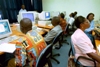 The Gambia was the first country to participate in the UNDP's
Internet Initiative for Africa programme to assist in creating
a low-cost Internet backbone running at 512Kbps via Teleglobe
in Canada, with local high speed POPs to provide national coverage.
The Gambia was the first country to participate in the UNDP's
Internet Initiative for Africa programme to assist in creating
a low-cost Internet backbone running at 512Kbps via Teleglobe
in Canada, with local high speed POPs to provide national coverage.
 The first ISP connected to the system was QuantumNet.
Online services that are commonly used in the by people are email,
web browsing, web hosting, discussion forum and file transfers.
Four Internet Service Providers (ISP); Gamtel,
QuantumNet and Netpage are licensed
to operate and to provide dial-up internet access to the public
and to institutions. The technology services provided through
dial-up system are cheaper in the Gambia than in many African
countries.
The first ISP connected to the system was QuantumNet.
Online services that are commonly used in the by people are email,
web browsing, web hosting, discussion forum and file transfers.
Four Internet Service Providers (ISP); Gamtel,
QuantumNet and Netpage are licensed
to operate and to provide dial-up internet access to the public
and to institutions. The technology services provided through
dial-up system are cheaper in the Gambia than in many African
countries.
With regard to internet connectivity, the
 survey
results revealed that on the average 46.2% of institutions covered
have had internet connectivity whilst 22.1% of the workplaces
interviewed have their own websites. survey
results revealed that on the average 46.2% of institutions covered
have had internet connectivity whilst 22.1% of the workplaces
interviewed have their own websites.
Training in the Use of ICT:
Status of ICT in Education sector:-
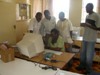 The
importance of information technology underscores the importance
of adopting IT in schools. The availability of computers in the
education sector is still very low, on the average and at national
level; student-to-computer ratio is 142 students per PC. The availability
of computers to pupils increases with increase in the level of
education. In fact, 256 students in Lower Basic School have to
share one PC whereas 10 pupils in tertiary / higher education
share a computer. In the urban areas, there are about 29 students
per PC in the Senior Secondary schools whilst there are only 11
pupils per computer in the Vocational schools. The
importance of information technology underscores the importance
of adopting IT in schools. The availability of computers in the
education sector is still very low, on the average and at national
level; student-to-computer ratio is 142 students per PC. The availability
of computers to pupils increases with increase in the level of
education. In fact, 256 students in Lower Basic School have to
share one PC whereas 10 pupils in tertiary / higher education
share a computer. In the urban areas, there are about 29 students
per PC in the Senior Secondary schools whilst there are only 11
pupils per computer in the Vocational schools.

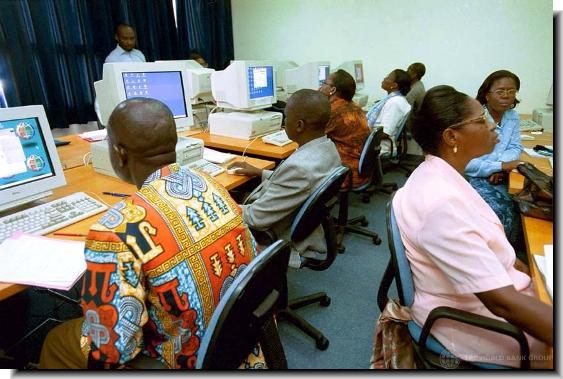
With regard to training received in the use of the IT, there are
disparities according to gender. Our survey results shows that
there are only 18 percent of the female students enrolled in tertiary
education who are in an ICT dominated field whiles there are about
60 percent of the male pupils in the same category who are in
an IT dominated field. However, the results concern with Vocational/Technical
schools show a higher participation of female in ICT field than
the males. There were 17 percent of female student in this school
category who are in an IT dominated field as against only 15 percent
of male pupils in the same school category are in an ICT dominate
field.
The proportion of students and teachers using the internet is
very high. About 98.4% of pupils and 98.9% of teachers used the
world wide web for email messaging.
Limitations
to Access to IT:-
Education-low literacy levels:
 To
develop the economy and improve the lives of local people we therefore
need a basic level of education underpinned by developing a learning
culture. The ability to use new technology that is ever changing,
acquire relevant knowledge and convey information in a manner
that empowers individuals to maximize their natural potential
perhaps stands out as the most basic prerequisite. In this regard,
opportunities to use ICTS has to be precluded by training and
learning. To
develop the economy and improve the lives of local people we therefore
need a basic level of education underpinned by developing a learning
culture. The ability to use new technology that is ever changing,
acquire relevant knowledge and convey information in a manner
that empowers individuals to maximize their natural potential
perhaps stands out as the most basic prerequisite. In this regard,
opportunities to use ICTS has to be precluded by training and
learning.
Low Skilled Workforce:
The proliferation of IT training will provide a future base but
now it is important we recognize that the relevant knowledge base
and therefore skills required to be competitive or have the competitive
edge are lacking. Before we even get in to the IT fields or the
lack of it in schools, what first comes to mind is the ongoing
debate about the atrocious level of English proficiency in schools.
Language forms a fundamental part of development and it is through
this that the principle of skill acquisition is based on regardless
of which skill one needs to acquire.
Awareness & Sensitization:
“Information is power” to empower and power to act. The completely
learning process for us in Africa and The Gambia specifically,
is challenged by how quickly we raise the level of awareness of
ICTs. At present, the information technology industry in
is focusing more on selling PCs, basic computer training, networking
and a few other basic services. The innovation to demonstrate
to people what a simple computer program can do for them or their
business that can translate to the need for PCs is lacking.
Affordability of Equipment & Services:
 Universal
usage to and affordability of are inextricably linked. The cost
of computers and the price of accessing the World Wide Web are
one of the main issues that influence the spread of ICTs. Purchase
of equipment is still far beyond the reach of the average citizen.
The high price tags compared to other necessities in life act
as a barrier to getting to use ICT equipments and services. Universal
usage to and affordability of are inextricably linked. The cost
of computers and the price of accessing the World Wide Web are
one of the main issues that influence the spread of ICTs. Purchase
of equipment is still far beyond the reach of the average citizen.
The high price tags compared to other necessities in life act
as a barrier to getting to use ICT equipments and services.
Gender Differences:
The high cost of PCs and connectivity keep IT services far beyond
the reach of most women. The infrastructure is largely urban-centred.
Internet content is overwhelmingly in English. Insufficient attention
is given to content in local languages and the use of the Internet
for women with low levels of literacy. Gender roles and other
cultural factors translates to the fact that women have less time
to make use of the latest equipment.
|




 Economy Sectors