 Introduction:
An agricultural census held in the early part of the first decade
reveals that 74 percent of farmers rear poultry. About 40 percent
of farmers reported having cattle, compared to 38 percent for
sheep and 58 percent for goats. The largest number of cattle is
found in Basse
(URD) and WRD. Major species of livestock in Gambia include cattle,
sheep, goats, horses, donkeys, chickens and pigs. Poultry and
small ruminant management activities have a high low productivity
rate and high mortality combined with yearly epidemics of Newcastle
Disease and PPR (Peste des Petits Ruminants).
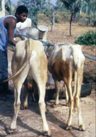 Most of the cattle breeds are either zebus or tsetse resistant
ndamas (a cross between the zebu & the West African Dwarf).
Most of the cattle breeds are either zebus or tsetse resistant
ndamas (a cross between the zebu & the West African Dwarf).
The livestock production system in Gambia contributes about 25%
of annual agricultural GDP and 5% of total national GDP. From
1980 the economic contribution of the livestock sector to the
Gambia's GDP has progressively increased from 4% to 5.5% with
the monetary value realized by the sector increasing from D18.1
million in 1982 to D28.3 million in 1996.
Vital Statistics of Livestock Units:
| |
Heads |
Growth Rate |
| |
2002 |
1990-2000 |
| Cattle |
327,000 |
1.1 |
| Sheep & Goats |
408,000 |
-1.8 |
| Pigs |
17,000 |
0.0 |
| Poultry |
591,000 |
0.7 |
| |
|
|
| Source:
FAO 2005a |
|
|
Gender Ownership of Ruminants:
Women play a major role in small ruminant production, representing
52% of the owners of sheep , 67% of the owners of goats and 43%
of the owners of both sheep and goats. The average number of animals
owned is quite low (about six head of sheep and goats each, out
of which about three are breeding females). Most of the breeding
males are born in their respective flock and there are fewer breeding
bucks than breeding rams.
Methods of Rearing:
The rearing method used is mainly traditional and most production
is targeted at the domestic market.
Overall traditional production is widespread and subsistence in
nature, with value laid more on the total numbers owned rather
than the economic values of stock. Livestock management is mainly
extensive pasture based form of rearing. In this regard the animals
are essentially free-range on harvested croplands during the dry
season being tethered in the evenings and limited to restricted
areas or tethered during the harvesting season.
Over the years livestock production has become more sedentary
in nature although, brief management is still being practiced
on a limited basis in some pastoral areas, especially in the CRD
(Central River Division).
During the non-rainy period as well as in bad years cattle move
between the floodplains and the woodland savanna in search of
water, greener pastures and to reduce the risk of outbreaks of
cattle diseases.
Ruminants such as sheep and goats a mainly sedentary being kept
in private compounds during the night time.
Draught / Working Animals:
Herdsman manage draught animals such as oxen, horses, donkeys
and milking cows through the semi-intensive rearing system. During
the rains when such livestock is resting they are usually tied
on field to graze. During the dry season they are hand fed with
straw or other vegetation.
Ram Fattening & Dairy Production:
In more recent times intensive management of small ruminants and
dairy cattle has taken place. During the 1990s projects for dairy
cattle production and ram fattening were set up. The ram fattening
was designed to increase non-crop income for farmers via intensive
feeding methods before the Tobaski Feast. The compound based dairy
project was designed for farm milk production and the cow dung
to be used to fertilize their fields. The Department of Livestock
Services is also promoting increased, village-based milk pasteurization
packaging and marketing of milk, and milk products, particularly
with women farmers.
See the PDF file
'Livestock Briefs' from the FAO
Department of Livestock Services
Marina Parade
Banjul, Gambia
Tel: 4228545, 4222087
|
|
|
|




 Economy Sectors


