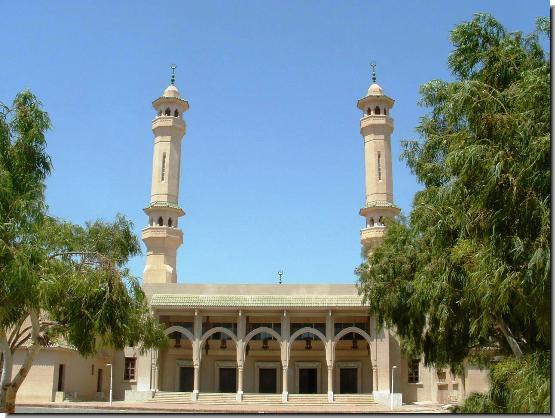
Introduction:
 Muslims
make up 90% of the Gambian population.
Most are Sunni though there are some people who belong to the
Shiite, Ahmadiyya & Bahai faiths in Banjul
& the Kombo region. Muslims
make up 90% of the Gambian population.
Most are Sunni though there are some people who belong to the
Shiite, Ahmadiyya & Bahai faiths in Banjul
& the Kombo region.
Islam & Everyday Gambian Society:
The religion has a very visible effect
on Gambian life but it has not completely eradicated traditional
beliefs in the majority of its believers. Most Gambians still
either engage in wearing the Juju (Terre), praying at sacred crocodile
pools, ancestor worship, animism, etc. This also includes some
Christians as well. Central
to almost every village is the mosque (Juma) or its smaller version
the Jaka.
It is from these places of worship that the call to prayer
is made with Friday being the Muslim Sabbath. The Islamic
Courts dispense justice in relation to the areas allowed it by
the Government and apply Malikite tenets.
Gambian Religious Practices:
You will often see people praying (called Juli) either in places
of worship (Juma) or out in the open after their ablutions. This
is just one of the five pillars  of
Islam that Gambians observe. The other four are a belief
in Allah as the one god & recognition of the prophet Mohammed
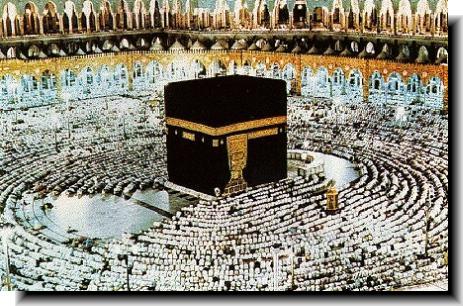
(pbuh) as his messenger. The third is to make a pilgrimage or
Hajj to Mecca at least once
in your lifetime, the fourth is giving to charity (Sarahh) and
the fifth is to fast (Werr i Korr) during the holy month of Ramadan.
Islam means surrender or submission to the will of God. of
Islam that Gambians observe. The other four are a belief
in Allah as the one god & recognition of the prophet Mohammed
(pbuh) as his messenger. The third is to make a pilgrimage or
Hajj to Mecca at least once
in your lifetime, the fourth is giving to charity (Sarahh) and
the fifth is to fast (Werr i Korr) during the holy month of Ramadan.
Islam means surrender or submission to the will of God.
Polygamy is also practiced as it is
not uncommon,  particularly
up-country, to find a man with up to 4 wives (Jabarr, wife). This
is seen by many locals as a mark of prestige and status in the
local community that they live in. This practice of keeping 4
wives however, is becoming less common among the middle classes
in the Kombos (west coast) and it may be more common to see a
man with 2 wives instead. The other aspects of a Gambian's religious
life you should be aware of is that they must not drink alcohol
(Sangarra) as it was originally forbidden because it interfered
with prayer or eat pork as it is considered unclean. particularly
up-country, to find a man with up to 4 wives (Jabarr, wife). This
is seen by many locals as a mark of prestige and status in the
local community that they live in. This practice of keeping 4
wives however, is becoming less common among the middle classes
in the Kombos (west coast) and it may be more common to see a
man with 2 wives instead. The other aspects of a Gambian's religious
life you should be aware of is that they must not drink alcohol
(Sangarra) as it was originally forbidden because it interfered
with prayer or eat pork as it is considered unclean.

|
|
Leaders of the religious society and interpreters
and teachers of religious law acquired a role analogous to European
Medieval clerics. The cleric was primarily a lettered man, a scribe.
But the French term given to Moslem clerics, Marabout, has a special
meaning through its identification with the cult of saints, a
cult which is a particularly important feature of Sufi (or mystical)
Islam. In this case it means a saintly man who has certain charismatic
qualities (such as Amadou Bamba) which enable him to attract large
numbers of followers to his teachings. As we use the term Marabout
today, he is a person who stands apart from the laity because
of the fact that he has received sufficient training in the Koran
and other Islamic matters to be recognized as a religious leader.
Note that the same term Marabout, which translates as Serigne
in Wolof and Thierno (or Ceerno) in Pulaar,
also refers to traditional healers and herbalists.
Devout persons acquire this training most often by assuming the
role of a disciple ("Taloube") of another recognized
Marabout from whom he receives years of training and guidance,
rather than by formal study at a school of theology. The Marabout
performs specific religious functions, leads prayers, teaches
the young, and presides over ceremonies and feasts.
Each mosque, whether in a small neighbourhood or for a whole city,
has an official who leads the prayers and is known as an "Imam".
Each smaller mosque has its Imam appointed by the community and
he usually holds that position for life. The "tablet school"
is where the lesser marabouts or clerics called "Ustaas"
teach children to recite the Koran, verses of which are written
on wooden planks. This is the first religious instruction of the
child, at about 4 or 5 years of age.
Gambian Religious Holidays & Festivals:
Ramadan
The Holy Month of Ramadan
is observed each year by Muslim people. more...
Koriteh (or Eid-il-Fitr)
The prayer day of Koriteh
immediately follows the end of Ramadan fasting in Gambia. more...
Tobaski
The Tobaski feast is
marked with the slaughtering of sheep throughout the country.
more...
Visiting a Mosque
If you want to visit one do go along with a Gambian Muslim friend
and only do so during non-prayer times. Before entering you must
take your shoes off. Women should cover all parts of their bodies,
especially their heads, except the feet, hands and face. Do ask
for permission to enter from whoever is properly in charge at
the time.
History of Islam in Senegambia
In the 11th century Futa Toro, in Senegal, converted to the Islam.
more...
|



 Culture & Traditions Religion