The
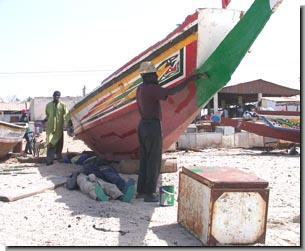
Serer (or Serrer, Serere as they are sometimes known) make
up less than 2% of the population of The Gambia. They are traditionally
fishermen and boat builders and can be found along the coastal
regions, as well as the entrance to the Gambia
River and in particularly Barra.
They and the Jola are believed to the
original first migrants to inhabit the country. The
Serer (or Serrer, Serere as they are sometimes known) make
up less than 2% of the population of The Gambia. They are traditionally
fishermen and boat builders and can be found along the coastal
regions, as well as the entrance to the Gambia
River and in particularly Barra.
They and the Jola are believed to the
original first migrants to inhabit the country.
 Traditional Social Structure:
 The
Serer had about 5 social class groups. First there was the ruling
noble class, then there were the soldiers or Tyeddo who
surrounded the ruling class, then there were the Jambur who were
the free-born commoners. Then came the group which belonged to
a series of lower castes based on occupation (artisans) with the
griot being the most socially significant and who frequently managed
to amass great wealth. However, like the Wollof
there was a social taboo about marrying into griot families and
their bodies were not allowed to be buried in the ground but instead
were placed in the branches of large baobabs. And finally there
were the slaves
who are further divided into two types: domestic and those captured
in war The
Serer had about 5 social class groups. First there was the ruling
noble class, then there were the soldiers or Tyeddo who
surrounded the ruling class, then there were the Jambur who were
the free-born commoners. Then came the group which belonged to
a series of lower castes based on occupation (artisans) with the
griot being the most socially significant and who frequently managed
to amass great wealth. However, like the Wollof
there was a social taboo about marrying into griot families and
their bodies were not allowed to be buried in the ground but instead
were placed in the branches of large baobabs. And finally there
were the slaves
who are further divided into two types: domestic and those captured
in war  or
bought and sold. The system of inheritance among the tribe was
through the female line (matrilineal). or
bought and sold. The system of inheritance among the tribe was
through the female line (matrilineal).
Political Structure:
The Serer had a Bur the highest
office in the land and was in control of state affairs and 'controlling'
the forces of nature. When he became quite elderly he was ritually
killed as their belief was that he was no longer able to ensure
the fertility of female members of the tribe or of livestock.
• History:
One theory for their origins are they came from Kaabu in Upper Casamance about 400 years
ago after a civil war ensued following the death of a prominent
chief. The losers of the war fled past Foni, across the Gambia
River and finally settled in Mbissel, present day Senegal.
The Soninke-Marabout wars however, displaced them yet again and
a few thousand refugees eventually arrived at Barra
and later some crossed over to settle in Banjul.
Upper Casamance about 400 years
ago after a civil war ensued following the death of a prominent
chief. The losers of the war fled past Foni, across the Gambia
River and finally settled in Mbissel, present day Senegal.
The Soninke-Marabout wars however, displaced them yet again and
a few thousand refugees eventually arrived at Barra
and later some crossed over to settle in Banjul.
The other theory is that they originally came from the territories
north of Senegal but were forced
by more powerful people to move to Futa Toro in Senegal and came
under the domination of Tukulors. Later
around the 12th century the Wollof tribe forced them to move south
west to Sine-Saloum. They established
small states there which later expanded to include the Gambian
states of Wuli and Niani
but Sine-Saloum came under Mandinka
control. However, Sere tradition, culture and society prevailed
so much so that the Mandinkas in these areas absorbed their language,
customs and culture.
Their Serer's new Mandinka rulers were known as the Guelewarr (or Gelwar) who were a branch of the tribe from Kaabu
known as the Nyanchos. In the late 1300s under Mansa Wali Jon
or as he became better known M'began N'dure they gained control
of Saloum from their Mandingo overlords and he became Bur or king.
By the mid 1500s they ruled both Sine and Saloum.
Guelewarr (or Gelwar) who were a branch of the tribe from Kaabu
known as the Nyanchos. In the late 1300s under Mansa Wali Jon
or as he became better known M'began N'dure they gained control
of Saloum from their Mandingo overlords and he became Bur or king.
By the mid 1500s they ruled both Sine and Saloum.
They were highly resistant to being converted to Islam
so the Soninke-Marabout wars of from the 1850s onwards under Maba
Jakhu Bah was waged against them which caused great devastation
of the land and loss of life. Many Serer fled to Barra,
on the north bank of the River Gambia to seek refuge and protection
from the British. Some were later allowed to cross the estuary
to the island of St. Mary, Bathurst
and the Kombo area. Other tribal members residing in Kaolack were
also forced to flee the wrath of the Jihadists and also moved
south into Gambia. They engaged in farming and fishing along the
coastal villages such as Bakau,
Gunjur, Kartong,
Tanji and Brufut.
The states of Sine-Saloum lost their independence in the latter
part of the 19th century when the French colonialists managed
to subdue them during the turbulence of the Soninke-Marabout wars.
Both the Burs of Sine and Saloum effectively signed away their
independence in 1891 in a treaties with the French making their
states French protectorates. The French agreed in return to allow
the hereditary line to continue for both rulers. |
|
 Culture
& Traditions
Culture
& Traditions
Languages

Aku
Fula
Jola
Mandinka
Serahule
Serer
Tukulor
Wolof
Other Ethnic Groups
|