Introduction & Origins:
 Some
statistics estimate that between the 17th and 19th centuries 1
in every 6 people taken as slaves from West Africa were from the
Senegambia region. Other
figures say that at the height of the trade in the 17th century
some 5,000 to 6,000 slaves were transported from The Gambia each
year on the 'Voyage of No Return'. This period is known as the
Triangular or Transatlantic
Slave Trade (Middle Passage). Some
statistics estimate that between the 17th and 19th centuries 1
in every 6 people taken as slaves from West Africa were from the
Senegambia region. Other
figures say that at the height of the trade in the 17th century
some 5,000 to 6,000 slaves were transported from The Gambia each
year on the 'Voyage of No Return'. This period is known as the
Triangular or Transatlantic
Slave Trade (Middle Passage).
 In
total 11.32¹ million people are thought
to have been transported alive to the Americas of which 55% of
(African Americans) of North Americans are thought to have come
from West Africa while 41% of them are believed to have come from
Central West Africa or South West Africa. Two thirds of those
traded were female, 10% died during capture or on their voyage.
The greatest African community in the Diaspora is believed to
be in Brazil with a population of about 200 million, followed
by the Caribbean and the U.S.A. In
total 11.32¹ million people are thought
to have been transported alive to the Americas of which 55% of
(African Americans) of North Americans are thought to have come
from West Africa while 41% of them are believed to have come from
Central West Africa or South West Africa. Two thirds of those
traded were female, 10% died during capture or on their voyage.
The greatest African community in the Diaspora is believed to
be in Brazil with a population of about 200 million, followed
by the Caribbean and the U.S.A.
The starting point for the trade in human cargo was in 1441 when
the Portuguese explorer, Antonio
Gonsalves, kidnapped 10 West African natives and shipped them
back to Lisbon. In Gambia the first
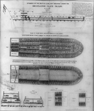 colonial
power to engage in slavery were the Portuguese. The first British
involvement in West Africa was in 1562 when Sir
John Hawkins seized about 300 locals from Sierra Leone and
sold them in the Caribbean (Spanish West Indies.) colonial
power to engage in slavery were the Portuguese. The first British
involvement in West Africa was in 1562 when Sir
John Hawkins seized about 300 locals from Sierra Leone and
sold them in the Caribbean (Spanish West Indies.)
From the 17th century onwards it was Britain that tended to dominate
the trade. At its height, in the 18th century, 50% of those shipped
across the Atlantic were taken by the British though other countries
such as Holland, Denmark, Spain, Sweden and the Norwegians all
became involved in shipping the so called 'Black Ivory' to North
and South America as there were huge profits to be made.
The Gambian Context:
 As
happened in other West African countries Europeans generally did
not travel inland to purchase or capture slaves but depended on
African middlemen who bought slaves from tribal leaders
and local chiefs in exchange for European goods including guns.
They then proceeded to bring them down to the coastal regions
to the European slavers. As
happened in other West African countries Europeans generally did
not travel inland to purchase or capture slaves but depended on
African middlemen who bought slaves from tribal leaders
and local chiefs in exchange for European goods including guns.
They then proceeded to bring them down to the coastal regions
to the European slavers.
Many chiefs saw an opportunity to accumulate substantial wealth
from the trade in battle captives. So as the demand for slaves
increased, so did inter-tribal warfare and attacks on other villages.
However, there are also many accounts of raiding parties where
villages were ransacked and raised to the ground in pursuit of
their human cargo.
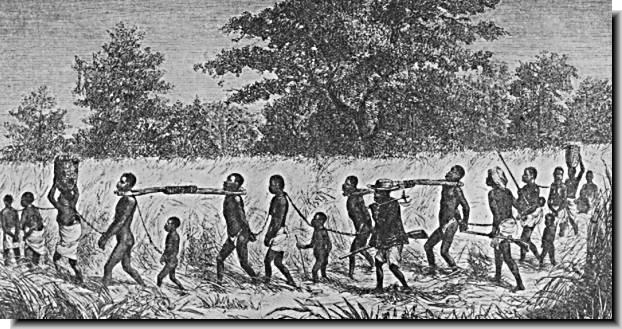
 One
historical account given by Francis Moore when visiting Gambia
in 1721 describes how merchants would bring ivory and sometimes
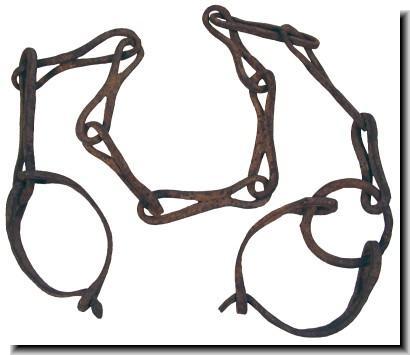
slaves who were bought from local chiefs. They were shackled by
the neck with leather tongs in lines of between 30 to 40 people
and at the same time hold either ivory or a bundle of corn in
each hand. One
historical account given by Francis Moore when visiting Gambia
in 1721 describes how merchants would bring ivory and sometimes
slaves who were bought from local chiefs. They were shackled by
the neck with leather tongs in lines of between 30 to 40 people
and at the same time hold either ivory or a bundle of corn in
each hand.
²Another historical
account of March 1814, states that an unnamed US square brig attacked
a ship originating from Liverpool just off the coast of Senegal
with inconclusive results. What later appeared to be the same
ship - thought to be owned by a Mr. James de Wolf (of Rhode Island)
- made an appearance in The Gambia a couple of days later under
Spanish colours and carrying 400 hundred enslaved Africans.
There were many small armed clashes between the various European
nations over ownership of a number of slaving posts which lay
along the River Gambia. This
included the skirmishes between the French and the British over
Fort James Island near Juffureh.
After abolition
in 1807 British traders complained that they were at a clear
disadvantage. They argued that the legitimate trade in peppers,
ivory, gum, wax and hides could not compete with the slave trade.
As a result in 1815 the Earl of Bathurst ordered the occupation
of James Island and any nearby areas which gave a distinct advantage
to foreign traders.
In 1831 war broke out between the British and the people on the
north bank state of Niumi partly because of the colonial power's
attempt to interfere with the slave trade by sealing the entrance
to the river. The Mandinka king of
Niumi, Burungai Sonko, and his people had benefited over the years
from taxing slave traders who wished to ship their human cargo
out of the country. In January, 1832 a peace treaty was signed
in Juffure in which Niuminkas
ceded control of their section of the river mouth to the colonial
power.
After the British abolished the slave trade it began a policy
of enforcing the ban by establishing a human settlement (1816)
on St. Mary's Island called Bathurst (Banjul).
This was to be the base of a military barracks with big guns to
guard against rogue nations who attempted to smuggle slaves out
of the Gambia's river mouth. Britain abolished
slavery in 1833. It was not until 1895, 88 years after the
abolition of the trade, that local Gambian chiefs decided to cease
trading in or keeping slaves. However, the practice continued
until the turn of the 20th century.
It should be noted that many African rulers and Europeans condemned
the trade throughout its history.
¹The Slave Trade
by Hugh Thomas
Simon and Schuster, 1997
ISBN 0-68481063-8
²Annual
Departmental Reports
Relating to
The Gambia
1881 - 1966 (UK)
|
|
Slavery Before the Europeans:
Indigenous slavery had existed in Gambia (including the rest of
Sub-Saharan Africa), well before the Europeans arrived (a somewhat
similar situation to ancient Rome). This was the case among tribes
such as the Mandinka and Wolof
(with the notable exception of the Jola
- though they did sell prisoners). However, much of this traditional
system was more akin to indentured servitude and generally speaking
domestic slaves had some rights.
That doesn't mean to say that harsh treatment was never meted
out to them as was the case with adulterers and sometimes to prisoners
of war. 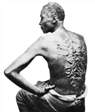 This
was in general contrast to the European system which saw all slaves
as having no rights. They being treated as personal property who
were subject to harsh disciplinary treatment on the whims of the
master. This
was in general contrast to the European system which saw all slaves
as having no rights. They being treated as personal property who
were subject to harsh disciplinary treatment on the whims of the
master.
Senegambian traditional society was made up of 1/3 slaves. In
the Wolof tribe they were at the bottom of the social scale and
were called jam or known as jongolu in Mandingo society. Such
people could find themselves in servitude as a result of being
a prisoner of war, by birth, convicted as a criminal or a debtor.
There were even those, who through destitution, voluntarily gave
up their freedom to a life of domestic bondage (though this last
group could have their freedom when they wanted.)
In his book "Travels
in the Interior Districts of Africa, 1795-1797" Mungo
Park who stayed at Jilifrey, opposite James Island, on the north
bank of The Gambia said:
"In
the account which I have thus given of the natives, the reader
must bear in mind that my observations apply chiefly to persons
of FREE CONDITION, who constitute, I suppose, not more than
one-fourth part of the inhabitants at large. The other three-fourths
are in a state of hopeless and hereditary slavery, and are employed
in cultivating the land, in the care of cattle, and in servile
offices of all kinds, much in the same manner as the slaves
in the West Indies. I was told, however, that the Mandingo master
can neither deprive his slave of life, nor sell him to a stranger,
without first calling a palaver (conference or meeting) on his
conduct, or in other words, bringing him to a public trial.
But this degree of protection is extended only to the native
or domestic slave. Captives taken in war, and those unfortunate
victims who are condemned to slavery for crimes or insolvency—and,
in short, all those unhappy people who are brought down from
the interior countries for sale—have no security whatever, but
may be treated and disposed of in all respects as the owner
thinks proper....".
Modern Day:
Today, there are those who are still labeled as belonging to the
'slave' group however, this is not literal and is acquired because
of one's birth lineage. Sadly, people are still forcibly taken
as slaves throughout the world and its abolition has not ended
the practice it has simply evolved and adapted itself to suite
the modern day.
The Gambia adopted to outlaw and punish those engaged in slavery
and having recourse to compulsory or forced labour. An anti-slavery
convention, entered into force on the 9th March, 1927 in Geneva,
was ratified on Wednesday 2nd April, 2008. Presenting the convention
to parliament for ratification, Marie Firdaus, Attorney General
and SOS for Justice highlighted the main features of the convention
such as the definition and prohibition of slavery.
List:
 African
Holocaust
African
Holocaust 
A site dedicated to the Motherland with contributions from black
academics.
Recovered
Histories
Trans-Atlantic history of the trade.
ThoughtCo.
Article about the Triangular Trade with detailed figures by West
African country.
Captive
Passage
Chronology
Divided into 10 sections from the starting point in 1441 to 1948.
Modern Day Slavery in Gambia
By Prof. Martin Patt (USA) reports on human trafficking in children
and women.
SlaveVoyages.org
 |



 History See also