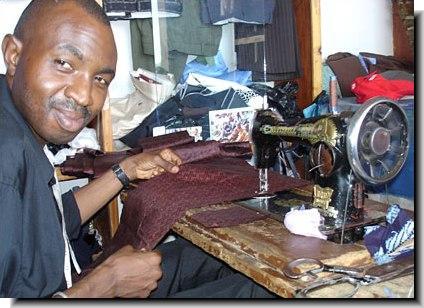
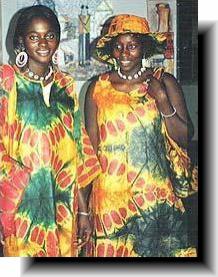
  If you buy fabric you fancy or have a craving for your own African
clothing, it is easy something sewed in any style you desire,
perfectly fitted to your own personal bod. An amazing service
at amazing costs.
If you buy fabric you fancy or have a craving for your own African
clothing, it is easy something sewed in any style you desire,
perfectly fitted to your own personal bod. An amazing service
at amazing costs.
There are
tailoring shops and stalls virtually everywhere in the Bakau area,
simply look around for signs as you ply the streets of New Town
and Bakau.
An inexpensive option is the tailoring shop at the
President's
Award Scheme (go through the
Rhun Palm Restaurant
to emerge in the back of the Scheme; the tailoring shop is in
the long building in front of you on your left, so walk forward
a few steps and turn left to reach the sidewalk of this building,
and the shop is the second door from the far end). The process
of getting clothes made is simple—buy fabric at the market and
give it to the tailor.
|
|
1. Material can be bought at the market, either a craft market
or a regular market (Banjul is highly recommended for selection;
Serrekunda is a bit closer but the shops farther in between). Fabric is usually
sold at a fixed price, though this is sometimes bargain-able,
depending on how much or what you are buying. The best bet might
be to ask if they can reduce the price for you, and they will
usually be honest if it is a fixed price.
is a bit closer but the shops farther in between). Fabric is usually
sold at a fixed price, though this is sometimes bargain-able,
depending on how much or what you are buying. The best bet might
be to ask if they can reduce the price for you, and they will
usually be honest if it is a fixed price.
Plain, solid, cotton is roughly $2 per meter. Linen fabrics are
far cheaper than you would pay in the U.S., at about $6 per meter.
Beware that many fabric shops sell pre-cut swatches of bright
prints—six yards is standard, enough to make African style garments.
If the fabric you want is flat and folded neatly, it would be
a good idea to ask if they can cut it for you before you set your
heart on it, or else you will have to buy all six yards.
2. Go to the tailor with your fabric and a clear idea of what
style clothing you want, whether it be a dress, pants, shirt,
skirt, or even suit jacket and pants. The tailor might sketch
what he perceives as your request, which you can approve or make
changes to. By far the easiest approach is to provide a tangible
example from your existing wardrobe—bring in a pair of pants that
can be a model for the pants to be.
3. The tailor will take your measurements. Agree on a price for
the garment, and a time when you should retrieve it.
4. Return to pick it up with cash in hand. Though it won't necessarily
be ready on the specified day, as tailors work on Gambian time
like everyone else. Try on the piece of clothing before leaving—the
tailor can make any necessary adjustments for a more suitable
size.
 |



 Dress Code