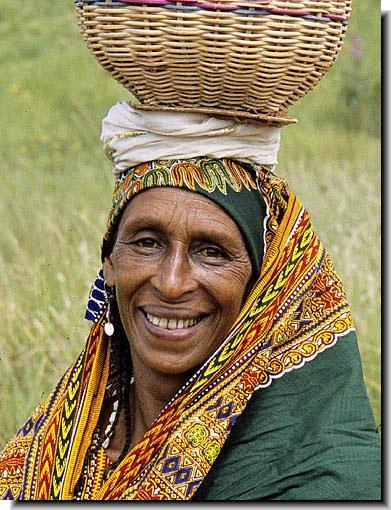
The
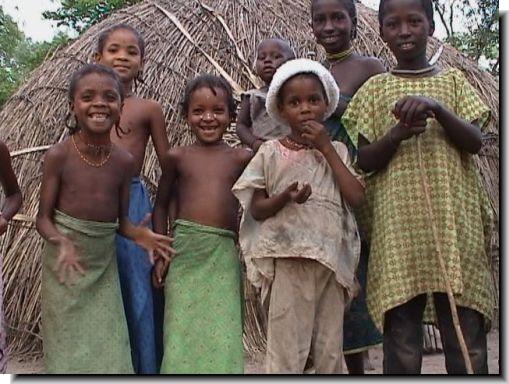
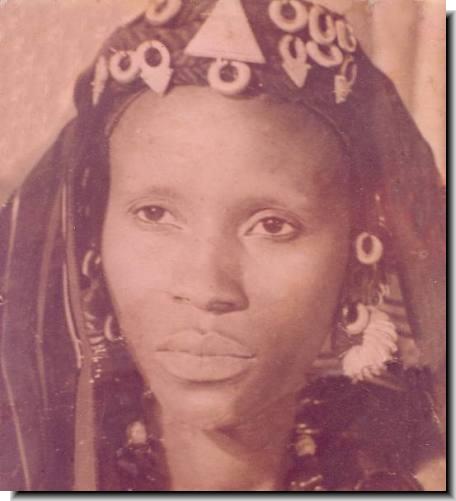
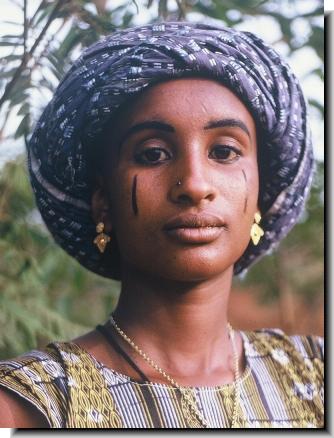
Tukulor ethnic group (or Tokolor as they are sometimes
known) make up less than 1% of the population
of Gambia. They are Muslim sedentary
farmers, cattle herders and fisherman. Today they are fairly widespread
in Upper Volta, Mali and Ivory Coast. Their name is from the Arabic
word Takrur which was a kingdom an 11th century central Senegal
River valley. They are closely related to the Fula. The
Tukulor ethnic group (or Tokolor as they are sometimes
known) make up less than 1% of the population
of Gambia. They are Muslim sedentary
farmers, cattle herders and fisherman. Today they are fairly widespread
in Upper Volta, Mali and Ivory Coast. Their name is from the Arabic
word Takrur which was a kingdom an 11th century central Senegal
River valley. They are closely related to the Fula.
 Traditional Social Class Structure
The Tuklor tribe traditionally had 3 distinct groups made up of
'castes' which have largely
remained untouched by their religious faith. First there is the
ruling class or Torodbe. Then there are the free-born made up
of agriculturalists, artisans, traders and clerical workers. At
the bottom are the 'slaves' (in name only). Marriage is confined
to the 'caste' in which you belong and there system of governing
their villages is carried out by a council of elders from the
ruling class.

History:
The Tukulor are thought to have their origins in Futa Toro
in present-day Senegal. One theory is that they are a branch of
the Fula called the Torodbe. Much
of their language (Haalpullar), customs, history and geographical
dispersion is similar to the Fula. Another theory is that they
are the offspring of unions between the Serer
and Wolof tribe.
Up to 1776 the Brakna Moors collected yearly taxes in the form
of grain called muddu hormma in Futa Toro. Partly because of this
resentment and the desire to spread Islam a militant Jihadist
movement emerged  under
Sulayman Bal, a Torodbe. In the 1760s and 1770s he won a number
of military victories in the valley of the middle Senegal River
against the pagan Fulani ruling dynasty, the Denianke, under Suleyman-Bubu.
Futa Toro eventually became a Muslim
theocracy in 1776 ruled by the almamys and a Muslim council. under
Sulayman Bal, a Torodbe. In the 1760s and 1770s he won a number
of military victories in the valley of the middle Senegal River
against the pagan Fulani ruling dynasty, the Denianke, under Suleyman-Bubu.
Futa Toro eventually became a Muslim
theocracy in 1776 ruled by the almamys and a Muslim council.
It was their desire to spread Islam
that resulted in them migrating to the north bank of Gambia as
well as other West African countries such as Mali and Hausaland
in Northern Nigeria. In Gambia, under the leadership of Maba Jakhou
Bah, they established a theocratic state in Baddibu. These migrations
into Gambia continued through to the early 1900s. Indeed they
claim that it was their ruler, the War Jabi, who was the first
black African ruler to convert to Islam and that the Tekrur Empire
was was founded by their people.
The French had however, through a number of treaties taken over
control of Futa Toro in 1891 after the murder of the Almamy named
Abdul Bokar Khan. By the end of the 19th century all Tukulor states
in Senegambia had lost their
independence to the French. |
|
 Culture
& Traditions
Culture
& Traditions
Languages

Aku
Fula
Jola
Mandinka
Serahule
Serer
Tukulor
Wolof
Other Ethnic Groups
|