Gambia Flag Home Page National Emblem
Home Page
Accommodation Flights Excursions Travel & Tourism


University of The Gambia
 
Education     Schools & Colleges
   
Contact Details:

Uni Gambia
Website: www.unigambia.gm

MDI Road
Kanifing South
The Gambia
West Africa

Telephone number:
4377198 (Faculty of Science & Agriculture)
4378815 (Faculty Building)
4372213 (Main switchboard)
4395065         "
4395062         "
4378769
4378812
4376266 (Professor Castillo's Residence)
4223791 (Marina Parade, Banjul)

Fax number:
Email: unigambia@qanet.gm

Registering as a UTG student:
To register with the college, you must go to the Accounts office in the Administration building (see “Administration building” map) to receive the pertinent paperwork which must be subsequently filled out and returned to the Senior Assistant Registrar’s office. This will be a group outing during orientation. You must provide two passport-size photos, one for the record and one for your Student ID card, which you can retrieve a few weeks later from the Senior Assistant Registrar’s office.

Choosing classes:
The class schedule will be posted at both the Faculty Building and the Administration Building (both on MDI Road). Note that the schedule will be adjusted slightly from its first draft; check the list daily for updates, especially if your class is listed sans location, time, and/or professor. Classes are three credits (plus one credit practical for some science classes) and are generally 1.5 hours long, twice a week. Suggested class load three classes, or nine credits. See below for list of possible classes.

Registering for classes:
To register for classes, you simply attend them and ask your professor to sign your add-drop form, which you will receive upon registration with the university. When you have gotten all of your professors plus your academic advisor to sign the form, return it to the Senior Assistant Registrar’s office. According to the student handbook, classes can be added and dropped until the fourth scheduled class—as this time period may vary greatly for each class, the Registrar’s office is reasonably lenient when it comes to this deadline. A grade of W (withdrawal) will be awarded past the add-drop period, provided at least 25% of instruction time remains.

Going to classes:
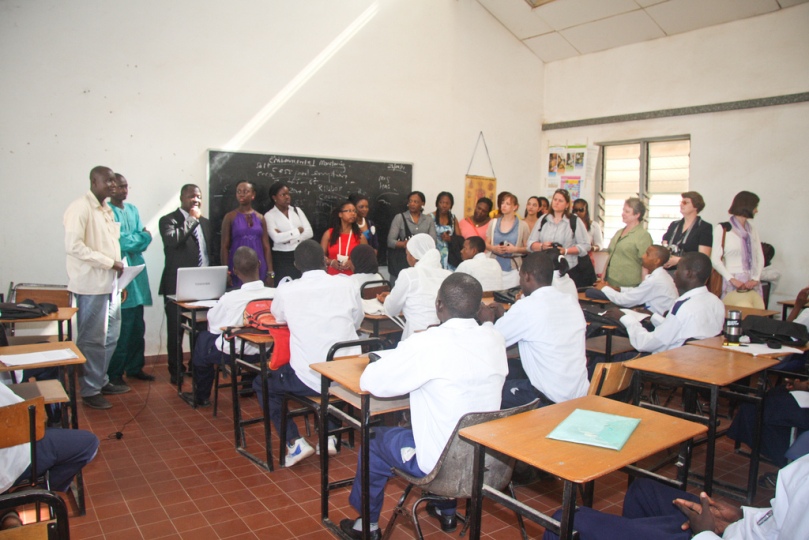
As you may have already been informed, the UTG has no single, unified “campus” as typical of standard universities, but consist mostly of rented buildings at sites sprinkled around the Greater Banjul area. Four university buildings are in Kanifing on MDI Road: the Faculty building, the Administration building, YMCA, and MDI (Management Development Institute). French classes are held at the Alliance Franco-Gambienne near Westfield, on Kairaba Avenue; a few classes are held in Banjul at the Nursing School and in Brikama at Gambia College. (Click on links for maps of these buildings/areas)

Classes may or may not begin the week classes officially begin. Being the only student in your first class of the semester does not necessarily mean you are in the wrong classroom—Gambian professors as well as students are usually slow to start the semester due to administration and transportation problems.


YMCA1/YMCA2: This denotes classes held at the Kanifing YMCA, in conference rooms number one and two, located above the restaurant on the second and third floors respectively. The YMCA also has a computer lab, open to students by special arrangement


KJ: Classes labelled KJ (short for Kal Jawara Memorial Block) are held at the MDI, the namesake for the road on which it is located.

Conference: Classes marked Conference are held in the Conference room in the Administration building.

“Faculty” is on the first floor of the Faculty building, entered from the left hallway.

The student Computer Lab is in the Administration building, in the hallway past the Accounting and Registrar offices.

Senate: This denotes the room where Senate meetings are held, on the second floor of the Faculty building, approached from the left hallway

Serekunda/Westfield:
ALL. FRAN. GAM: This is short for Alliance Franco-Gambienne, located on Kairaba Avenue, near Westfield junction. (Note that "Alliance" is pronounced the French way, AL-ee-onts). There are three main options for getting yourself there from the hotel—shared taxi, walking, and biking. If you elect to go by shared taxi, take transport towards Westfield for about $0.15. Plan accordingly—as the Alliance is fairly far down Kairaba, this journey can take anywhere from five to fifteen minutes, depending on stops and traffic. When you see Latrikunda Senior Secondary School on the right-hand side of the road, know that you are getting close; prepare to alight when the Alliance’s red and white sign pops into view, also on the right. (See “Location of Alliance Franco-Gambienne on Kairaba Avenue” map)

Walking will take quite some time; with a bike the trip will take about 15-20 minutes, but beware of the dangers of morning and midday traffic on the short stretch of Kairaba. The best route to take is following MDI Road to its end, taking a right and following Post Office Road to its end, and taking a left onto Kairaba Avenue, where the Alliance is about 2 minutes up the road, on your right.

Inside the Alliance, several classrooms are used for university classes. (See “Alliance Franco-Gambienne” map). They will most likely be held in the classrooms that are located to the left of the lobby (if the front entrance is at your back).

Banjul/Brikama:
Some classes (mostly science-based courses) are taught at the School of Nursing (Banjul) and Gambia College (Brikama). The university currently has one working bus that offers transport from Kanifing to the classes in Banjul and Brikama. When the course schedule is completed, the Transportation Committee will prepare a bus schedule and post it on the bulletin board at the Administration Building. The bus can hold up to twenty-two students and costs about $0.10 for each one-way journey. The alternate transportation for each venue (taxi) will be explained in detail below.

BANJUL: Classes in Banjul are held at the School of Nursing, in the auditorium. By bush taxi, catch a van to Banjul; get off at the last stop in Banjul and use the “Downtown Banjul” map to guide you in walking to the School of Nursing. (The garage on this map is denoted by a picture of a taxi.)

BRIKAMA: Classes marked Brikama are held at Gambia College; these are usually laboratory classes. Take a bush taxi to Westfield, from there find a taxi going to Brikama (see also Taxi). You will see a sign for Gambia College on your right, where you should alight.

Faculty/staff offices:
Due to the limited resources of the university, most lecturers do not have offices. For information on how to contact them, visit the appropriate Faculty Officer who can usually provide you with a home or mobile number. The locations of the offices are as follows:

HUMANITIES/SOCIAL SCIENCE: Second floor of the Faculty Building

ECONOMICS/MANAGEMENT: Library (see “Resources” below)

SCIENCE/AGRICULTURE: Third floor of the Faculty Building

MEDICINE/ALLIED HEALTH: Offices are located at the School of Nursing and Royal Victoria Teaching Hospital, both in Banjul.

ADMINISTRATIVE STAFF: Located in the Administration Building. This includes the Registrar, Accountant, Personnel Officer, and the Vice Chancellor. An exception is the Deputy Vice Chancellor, who doubles as the Dean of Humanities/Social Sciences and has an office on the second floor of the Faculty Building.

Top of Page
Grading system:
Grading at the UTG is calculated as follows:

57-59%
C+
2.3
90-100%
A+
4.3
54-56%
C
2.0
80-89%
A
4.0
50-53%
C-
1.7
70-79%
A-
3.7
40-49%
D
1.0
67-69%
B+
3.3
0-39%
F
0.0
64-66%
B
3.0
Withdrawal
W
0.0
60-63%
B-
2.7

Final grades are released once they have been through a thorough verification process:

1. The professor submits a form containing each student’s grade for each test/assignment (usually about 50% of the grade), the final exam grade (also about 50% of the grade), the calculated percentage out of 100%, and the equivalent final grade.

2. The grades are sent to the Senate for review
A. All final percentages/grades are recalculated to ensure no mathematical error was made by the professor.
B. The Senate looks at the grade distribution, keeping an eye out for seemingly skewed results, i.e. an outstanding number of A+’s or a remarkable number of failures. If all seems well, the grade report is sent to the registrar to be officially entered on the student’s record.

3. On rare occasions, when the grade distribution seems questionable or unusual, the grade report is sent for review by the appropriate faculty board, who attempt to determine the reason for the unlikely allotment of grades. Assignments and tests will be reviewed to see if they were appropriate for the class and if they were justly marked. The faculty board may elect to make grade revisions if deemed necessary. Finally, the reviewed and possibly adjusted grade report is sent back to the Senate for approval. If approved, it is sent to the Registrar for documentation.

4. As the grading system is a rather long process, UTG students can expect final grades by August or September; you can expect.

Final exams:
Final exams are held starting a few days after the official end of classes, usually lasting for a week. They are two hours long and in most cases count for 50% of the grade. As the end of the semester nears, the exam schedule will be posted at the Administration and Faculty buildings. If extenuating circumstances prevent you from taking an exam (such as an unchangeable a flight back to America), an earlier sitting must be arranged by your professor and approved by the Dean of the appropriate faculty. In this case, it is best to ask for assistance from your academic coordinator.

Resources:
Textbooks are usually not required for classes; for most course readings, lecturers will photocopy either selections or entire texts. These must be picked up and paid for by each student from the Accountant in the Administration Building. Costs can range from about $0.50 to $5.00 per packet. Sometimes a lecturer will assign a textbook that is available on a loan from the university; you must also retrieve these books from the Accountant. On occasion, students can sign up to order various textbooks for supplementary reading (in the spring semester of 2004 the books arrived shortly before the semester’s end).

For research assignments, there are computers with internet connection (a very slow internet connection) at the Administration building, for exclusive use by UTG students. (See also Internet). The University library has some useful books—though as most were donated by overseas universities, many are outdated. The University Library is located off Kairaba Avenue, well marked by a series of signs bearing arrows (number 69 on “Bakau to Serekunda area” map); one book may be taken out for a maximum of two weeks provided you present your UTG identification card. The National Library in Banjul is better stocked; up to two books can be borrowed for up to two weeks, pending the one-time payment of about $2.15 for a membership. The National Library is located on the road just before Arch-22. Alight from the bush taxi at the footbridge, and turn right on the road in front of you (Gambia High School is located on the corner). The library located ahead on the left-hand side of the road.

Courses available:
As the University is constantly developing, course offerings change each year. New classes are offered each semester and some classes are not offered regularly due to lack of professors and/or space. You will likely see from 120 to 150 classes appear on the class schedule, which during registration will be posted on the bulletin board of the Faculty building (see "Faculty building" map). You can also ask your academic coordinator for access to a copy of the latest course catalogue, though not all classes listed will be offered the semester you are attending.

Top of Page


 Top of Page


Top of Page
  
Home  |  Disclaimer & Legal Notices Contact
© Copyright 2008 Access Gambia  All Rights Reserved.