Contact Address
Details: Contact Address
Details:
National
Water & Electricity Company Ltd.

Website:
www.nawec.gm
Banjul area Head Office
53 Mamady Manjang
Highway
Kanifing Municipality, Kmc
PO Box
609, Banjul
The Gambia, West Africa
Tel no: 4375958
4376607, 4392218
Fax: 4375990
Email: info@nawec.gm

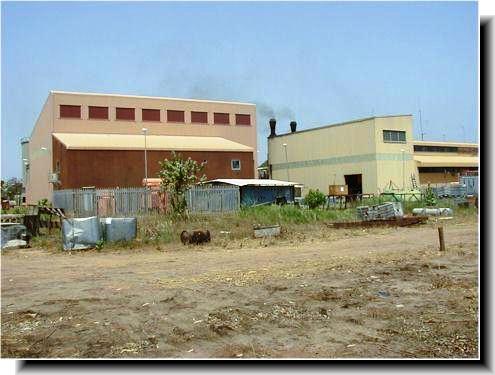
Power Station location: Kotu Quarry.
Enquiries & Complaints: Tel: 169 (24 hours)
Head Office, Fajara M Section
|

NAWEC Gambia Ltd. is the country's main utilities supplier. It was incorporated
in June, 1996 as a company limited by shares under the Companies
Act of 1955. Its main Kotu Power Station is the principal generator
serving the Greater Banjul Area in the Kanifing Municipality.
Nawec is involved in the generation and provision of electricity,
drinking water & sewerage services for domestic, industrial
& commercial uses. The regulatory authority, PURA, has the
mandate to regulate the electricity and water markets in the Gambia.
Ltd. is the country's main utilities supplier. It was incorporated
in June, 1996 as a company limited by shares under the Companies
Act of 1955. Its main Kotu Power Station is the principal generator
serving the Greater Banjul Area in the Kanifing Municipality.
Nawec is involved in the generation and provision of electricity,
drinking water & sewerage services for domestic, industrial
& commercial uses. The regulatory authority, PURA, has the
mandate to regulate the electricity and water markets in the Gambia.
History:
The creation of Nawec can be
followed back to the year 1972, when the Gambia Utilities Corporation
Act created the GUC
to supply and conserve electricity and water for the general public,
industry and domestic households. GUC was formally dissolved in
1993 following a Presidential Executive Order. The Management Services Gambia
Ltd. (MSG) and the Utilities Holding Corporation
(UHC)
were asked to take over the functions of GUC.
Under the new agreement the responsibility of managing the asset's
profitability was given UHC
while MSG (owned by a French company, SOGEA)
was awarded the operating lease. MSG's lease was ended by the
Government on the 23 February, 1995 thereby leaving the management of
assets and operations to UHC.
In June 1996 MSG and UHC had amalgamated to form the NAWEC we know
today. can be
followed back to the year 1972, when the Gambia Utilities Corporation
Act created the GUC
to supply and conserve electricity and water for the general public,
industry and domestic households. GUC was formally dissolved in
1993 following a Presidential Executive Order. The Management Services Gambia
Ltd. (MSG) and the Utilities Holding Corporation
(UHC)
were asked to take over the functions of GUC.
Under the new agreement the responsibility of managing the asset's
profitability was given UHC
while MSG (owned by a French company, SOGEA)
was awarded the operating lease. MSG's lease was ended by the
Government on the 23 February, 1995 thereby leaving the management of
assets and operations to UHC.
In June 1996 MSG and UHC had amalgamated to form the NAWEC we know
today.
Ownership:
It has an authorized share capital of D500 million (50 million
shares valued at D10 per share). The government currently owns 92.7%
of the fully paid shares, SSHFC 5.8% and GPA 1.5%. The intention was
for NAWEC to be owned 97% by government. Once the shareholders pay the
original designated amounts the percentage shareholding will be as
originally contemplated.
Private Involvement:
Potential Divestiture Strategies:-
Public / Private Partnerships (PPPs)
Independent Power Producers (IPPs)
Privatize billing & other support services
In 2006 the Electricity Law was passed that has opened up the generation component of the electricity
sector to private investors and an Independent Power Project (IPP)
of 23MW capacity was expected to begin power generation in
July / August 2006. The law also allows for private sector
participation in the distribution of electricity. In October, 2006 the
Gambia Government announced that it had signed a 5-year contract, its
first Power Purchase Agreement (PPA), on
on Friday 28th September, 2006, with Global Management System, and
Independent Power Provider, to take
over electricity generation only from
Nawec. The director of GMS is Muhammad Bazzi.
Operational Problems:
As a public
enterprise, it was not operating on a commercial basis and
couldn't
generate sufficient financial revenues to maintain and upgrade
the systems & infrastructure.
Supplying electricity on a
commercial basis is marked by a number of problems. These include
under-investment, an inflexible tariff system, rising fuel prices,
distribution and transmission losses and non-payment of large bill
arrears particularly by large commercial & industrial consumers. As a
result, the company has huge difficulties in meeting its operating
costs, investing in generation capacity expansion and replacing
obsolete equipment. Despite the fact that NAWEC has managed to achieve
financial sustainability for its normal operations, it has limited
resources to properly expand the electricity system. As a result the
system is not robust enough to meet the growing demand and requires
significant investment to operate efficiently.
Local Generating Capacity:
In the
rural areas, NAWEC is operating 6 small scale
power systems served by stand-alone electricity subsystems in the
provincial centres of Bansang (420KW), Janjanbureh (270KW), Kerewan
(142KW), Basse (640KW), Farafenni (400KW), Mansakonko (400KW).
Juffureh and Kamuna are smaller stations that serve NAWEC's water
reticulation systems in their respective areas. The total installed capacity
is 2.272 MW at these power stations and is often less than the total
instantaneous demand, whose peak is estimated to be about 2.8 MW in
1999. These power stations operate on diesel generator sets that feed
into isolated medium and low voltage networks which when available,
supply electricity for 12 - 15 hours a day. These systems lack
sufficient installed capacity. These centres are also not
self-sustaining in terms of revenue and depend on subsidy revenues
generated in the Greater Banjul Area (GBA).
Besides only serving a small
customer base of 2,640 customers, the provincial power stations provide
the essential electricity supply for the water reticulation systems in
Farafenni, Basse, Bansang, Mansakonko, Jangjanbureh, and Kerewan. At present, a
Rural
Electrification Project is underway and has entered its
final phase.
Legal Framework
&
Sector Policy:
• Draft Energy Policy
• Electricity Law Enacted
No. of Employees:
| Description: |
Staff numbers: |
| Permanent |
837 |
| Contract |
12 |
| Casual |
135 |

|
Electrical Distribution Structure:
 In
Gambia
electrical power is by thermal transmission and is
transmitted for distribution via 5 radial 11-kilo volt (kv) feeders
and three 33 kv feeders that form a ring in the GBA. The 33 kv feeders
feed medium voltage substations where the voltages are transformed to
11 kv for distribution. In
Gambia
electrical power is by thermal transmission and is
transmitted for distribution via 5 radial 11-kilo volt (kv) feeders
and three 33 kv feeders that form a ring in the GBA. The 33 kv feeders
feed medium voltage substations where the voltages are transformed to
11 kv for distribution.
 NAWEC'S
generating capacity is located in one major power
station on land in Kotu in the Greater Banjul and
stand alone stations in the provincial towns. NAWEC'S
generating capacity is located in one major power
station on land in Kotu in the Greater Banjul and
stand alone stations in the provincial towns.
The current maximum available
capacity at Kotu Power Station is 25.3 MW at peak load times.
Most of the generators at Kotu use Heavy Fuel Oil (HFO), which is
contributing to foreign exchange difficulties in meeting the
country’s import needs and the negative environment
impacts from the emission of greenhouse gases.
The provincial generators are run on diesel fuel.
The provincial inland energy networks are not connected
to the Kotu transmission system. By end of 2005, NAWEC
had a total customer base of 54,976 in 990 zones grouped
into 6 categories.
Water Provision:
 Nawec is also
responsible for the supply and conservation of potable water. Its
activities are largely confined in the GBA and the ten Provincial
Growth Centres. Water in the GBA is obtained from
the underground water table. In the 5 administrative regions, potable
water service delivery is as the need arises, and is provided by numerous
bodies
using various techniques. The Area Councils have legal
responsibility for water supply but resource limitations and technical
capacity means that services are primarily delivered through specific
donor funded projects and UN funded projects. Nawec is also
responsible for the supply and conservation of potable water. Its
activities are largely confined in the GBA and the ten Provincial
Growth Centres. Water in the GBA is obtained from
the underground water table. In the 5 administrative regions, potable
water service delivery is as the need arises, and is provided by numerous
bodies
using various techniques. The Area Councils have legal
responsibility for water supply but resource limitations and technical
capacity means that services are primarily delivered through specific
donor funded projects and UN funded projects.
In 2005 12,689
cubic metres of water was sold representing a negative growth rate of
- 6.26. The drop in sales could either be attributed to losses in the
reticulation system or illegal connections. In the same year
D89,378,992.78 was collected in revenues. The following table shows the various well fields and
the number of boreholes in each well field.
Sewage:
The only sewerage systems in The Gambia
can be found in the capital at Banjul, and few hotels in the Kanifing Municipality
(KMC). Banjul
has about 3,000 customers and total turnover in 2005 was D4
million. The sewage service delivery system is heavily
subsidised by the other divisions of NAWEC, such as electricity, since
its revenues cannot cover its operational running costs.
Leaks:
The company's policy is that
it is the customer’s responsibility to protect themselves against
losses through leakage after the water meter.
News:
On the 5th December, 2007 it was announced that the National Electric
Power Company of Jordan (NEPCO) would assist in the upgrading of the
electricity sector under a $310,000 agreement.
In the middle of March, 2009, the government of The Gambia, in
conjunction with NAWEC, purchased two new 50 megawatt generators to
increase the national energy supplier’s electricity generating power.
The machines were transported to Brikama Power Plant for installation.
|
|