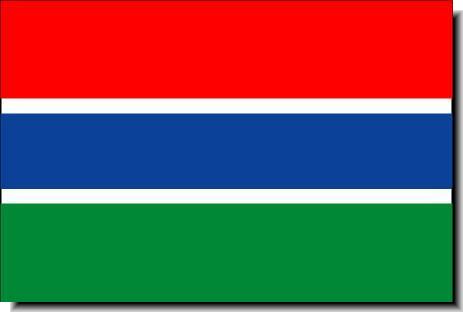
Official Name:
Government of The Republic of The
Gambia.
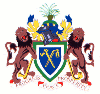 The
Gambia is a multi-party democratic republic
within the Commonwealth; independent since 1965; and an Executive
Presidency established in 1970. The 1970 constitution was revoked
following the July 1994 military coup. The
Gambia is a multi-party democratic republic
within the Commonwealth; independent since 1965; and an Executive
Presidency established in 1970. The 1970 constitution was revoked
following the July 1994 military coup.
The Constitution of the Second
Republic of The Gambia, which was approved in a national referendum
on 8 August 1996, came into effect on 16 January 1997. Under its
terms, the Head of State is the President of the Republic, who
is directly elected by universal adult suffrage and holds executive
authority. Legislative authority is vested in the National
Assembly, which serves a five-year term and comprises 53 members
- 48 of which are directly elected and 5 appointed members. The
President appoints government members,
who are responsible both to the Head of State and to the National
Assembly. The president's official residence is State House.
After 200 years of British Colonial
rule, The Gambia became independent on 18th February 1965
and 5 years later in April 1970-adopted a republican constitution.
The Gambia, a multi-party republic within the Commonwealth, is
administered by an Executive President. Under the current constitution
general elections through secret ballots are held every five years
to elect candidates who constitute the country's House of Parliament.
For administrative purposes the country is divided into The Capital
and Seat of Government together with the adjoining Kombo St. Mary
and the provinces are in turn divided into five Divisions (now
known as regions), each headed by a Commissioner who is the administrative
head. These divisions, are further sub-divided into 35 districts
locally administered by Seyfos (chiefs). Each district covers
a number of villages and settlements with the Alkalo
as the village head.
The
Judiciary
The Gambia judicial system is similar to the system found in most
countries with Common Law Jurisdiction. There is only one system
of courts which form a hierarchy. The subordinate courts consist
of (a) Khadis (Muslim) Courts, (b) District tribunals, and (c)
Magistrates courts. These courts have limited jurisdiction to
hear both civil and criminal matters before them.
At the higher level, there are the Supreme Court and The Gambia
Court of Appeal.
Political
Parties
Main Political Parties:
APRC - Alliance for Patriotic Reorientation and Construction
GPP - Gambian People's Party
PPP - Progressive People's Party
UDP - United Democratic Party
 Legislature
The parliament of Gambia is called the National
Assembly and is a Unicameral parliament. Consisting of 53
members, 48 of which are directly elected for a term of 5 years.
The Constitution
The Gambia's earlier Constitution came into force on 24th April
1970, when the country became a republic. Its major provisions
are summarised below: See also the current constitution.
Executive power is vested
in the President of State and Commander-in-Chief
of the armed forces. Following a constitutional amendment in March
1982, the President is elected by direct universal suffrage, and
serves five-year term. The President appoints the vice-president,
who is leader of government business in the House of Representatives,
and other Cabinet Ministers
from members of the House.
Legislative
power is vested in the unicameral National
Assembly, with 53 members: 48 elected by universal adult suffrage
and 5 appointed by the president.
Suffrage: 18 years of age; universal.
Since the Military take-over on July 22nd 1994, the APRC Government
has made a few amendments to the constitution
of The Gambia's but the Judiciary has remained the same. The new
government has also established a constitutional review commission
(CRC) which is charged with the responsibility of reviewing the
present constitution in order to make it more responsive to the
needs and aspirations of the people of The Gambia.
Both the British and United States governments as well as the
United Nations Development Programme (UNDP)
provided technical and financial assistance to The Gambia for
the APRC Transition Programme for economic and social development
and the steady return to democratic civilian rule in July 1996.
|
|
|
|