 |
 |
||||
 |
|
||||
| Agriculture & Farming in Gambia | |||||
|---|---|---|---|---|---|
 |
|||||
 Economy Sectors
Crops Fisheries
Forestry
Economy Sectors
Crops Fisheries
Forestry
|
|||||
|
|||||
 Livestock
Food Products History
Suppliers
Livestock
Food Products History
Suppliers |
|||||
 Agricultural Sector:
 The
main cash crop of The Gambia is groundnuts.
The country is primarily a agricultural country with 80 percent of the
population of just over 2 million depending
on agriculture for its food and cash income. The farming economy
is the only means of income creation for the majority of rural families
most whom live below the poverty
line.
Statistics: The
main cash crop of The Gambia is groundnuts.
The country is primarily a agricultural country with 80 percent of the
population of just over 2 million depending
on agriculture for its food and cash income. The farming economy
is the only means of income creation for the majority of rural families
most whom live below the poverty
line.
Statistics: The
agricultural sector is the most important sector of the Gambian economy,
contributing 32% of the gross domestic product, providing employment
and income for 80% of the population, and accounting for 70% of the
country's foreign exchange earnings. It remains the prime sector to
raise income levels, for investments, to improve food security and reduce
levels of poverty. The
agricultural sector is the most important sector of the Gambian economy,
contributing 32% of the gross domestic product, providing employment
and income for 80% of the population, and accounting for 70% of the
country's foreign exchange earnings. It remains the prime sector to
raise income levels, for investments, to improve food security and reduce
levels of poverty. About 54% of the land area in The Gambia is good quality arable land (5,500 square kilometres), out of which about 39% (1,880 sq. km) is currently farmed by the 41,000 subsistence farmers in The Gambia. About 810 sq. km. (81,000 hectares) are irrigable, all in the (CRD) Central River Division (56%) and (URD) Upper River Division (44%). About 2,300 hectares of this potential area, are currently under irrigation. Crop production is quite diversified. Cash crops such as cotton and groundnuts are grown in the up-land areas and rice in lowland, riverine areas (rain-fed swamps or under irrigation) for both subsistence and cash. Other principal subsistence cereal crops grown are maize, sorghum and millet. When the sector is looked at by gender 51% are women.
Climate:The climate is largely semi-arid with one wet season followed by a seven month dry season. The rainy season commences from June and continues to October. Average daily temperatures are 28.2° C in the dry season and 28° C in the rainy season. Low levels of soil moisture prevailing in September and October, can adversely effect crop harvests.
Agro-ecological zones: Based on the rainfall pattern, there are 3 major agro-ecological zones in Gambia namely Sahelian, Sudan-Sahelian and Sudan-Guinean zones. The Sahelian Zone has a Sahelian micro-climate with open dry season savannah vegetation. Rainfall is unpredictable and less than 600-mm total annually, with an effective crop-growing season of less than 79 days. Soils have low water retention capacity and this is a high-risk area for long-duration crops. Thus early maturing, short-duration and drought tolerant crops are cultivated in this zone. Cassava, sesame and cowpea are the main produce with millet grown only occasionally because of the risk that birds would consume their crop. The Sudan-Sahelian Zone lies within the 600 to 900 millimeter rainfall area. With a longer growing season, 79 to 119 days, the up-land areas are well suited to groundnut, cotton and sorghum. The flood plains along The Gambia River and associated lowland valley systems are an excellent rice growing catchment under tidal swamp irrigation. The Sudan- Guinean Zone lies within the 900 to 1200 mm rainfall isohyets. The growing season is 120-150 days and in normal seasons full crop water requirements are met throughout the growing season. In some lowland areas the long dry season results in increased salinisation of The Gambia River and an emphasis on saline tolerant rice varieties. The principal crops cultivated in this agro-ecology are early millet, groundnut, rice (rain-fed upland and lowland, irrigated lowland, mangrove and mangrove salt-tolerant), maize, vegetable, sesame and cowpea.
Social Organisation of Production:Gender Divisions- 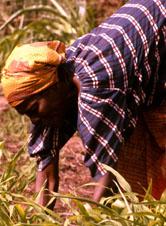 Apart
from pump irrigated rice (mostly controlled
by men), traditional lowland swamp or river-bank rice is mainly women's
responsibility, but with variation among ethnic
groups, particularly in terms of control of produce. Apart
from pump irrigated rice (mostly controlled
by men), traditional lowland swamp or river-bank rice is mainly women's
responsibility, but with variation among ethnic
groups, particularly in terms of control of produce.Among the Mandinka both kamangyango and maruo rice production is carried out by women farmers. The female sinkiro head controls the maruo rice. Men rarely help women with their crops and women return the favour and do not assist men with their upland crops, even during the busy weeding and harvesting period. Within the Jola community women are the principal rice growers. 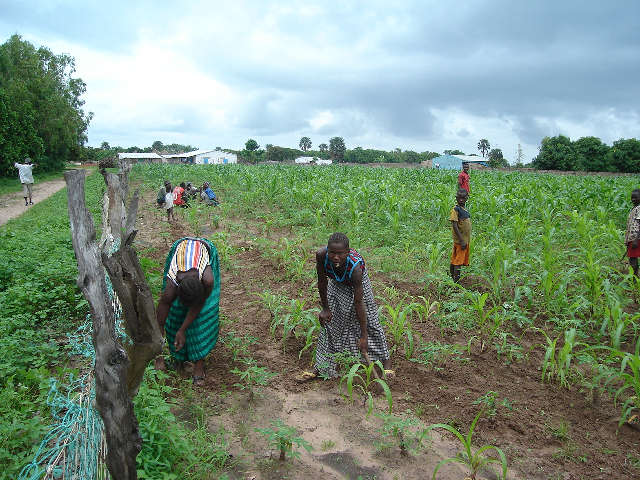 The majority of maruo rice is controlled by a male sinkiro head.
 Among the Wolof and Fula, who have only begun growing rice in the past two decades, the gender division of labour and control of the rice crop tends to be more flexible. Rice is still mainly grown by women but men are likely to contribute. The maruo rice crop tends to be managed by the male sinkiro head. Agriculture is communally organized among Gambian farmers. It is therefore important to develop a basic understanding of Gambian rural families in analyzing the farming systems that have developed over the years.
Compound:A family unit consisting of dwellings and a private yard. Smaller sub-divisions of the compound are the Dabada and Sinkiros.
Dabada:Dabada is defined as the farm production unit in which two or more individuals (within the same compound) cultivate farms, outside the communal farm, for their own individual needs.
Sinkiros:Sinkiros refers to the cooking and consumption group within or outside the compound. Sinkiros provide basis for the compound’s organisation of storage, processing and consumption of foods. The women in the Sinkiro group are responsible for cooking on rotational basis. In many cases, the dabada unit coincides with the Sinkiro, as members not only work together, but may also eat together. Two types of farm units are common: the communal farm called Maruo and the individual or private farm known as Kamanyango. Maruo consists of a set of fields on which all members of the compound unit, usually men and women separately, cultivate together to provide the bulk of food required for the subsistence of the compound members. The compound head makes allocation of food and produce from the granary to each participating family according to its needs. Kamanyango farm: Individual members (male or female) of the compound can clear land and create private farms (Kamanyango) on which they work to produce food and other crops to provide for the extra needs of their immediate families and to supplement the main portion received from the central pool. The Compound head may assign certain days in the week or hours of the day for communal work, to ensure that both the interest of compound and those of its individual members are catered for.
Land Tenure:In The Gambia, each village has an identifiable area of land that falls within the jurisdiction of its own headman (Alkalo). The land is usually not legally registered. Families or individuals in a village establish claim over a piece of land by tracing their decent, more often patri-linearly to the first settlers. The Alkalo has the power to allocate land to compounds in the village. Any compound head has the right to clear un-claimed land within the village’s area of jurisdiction. The piece of land is thereafter held in perpetuity by the compound that first cleared it. The inheritance laws provide for the transfer of compound land to the next eldest male member of the family in case the compound head dies; thus stabilizing the degree of land fragmentation that is allowed to occur. There are 3 main avenues for a woman to obtain land (alluvial rice land or swamp): (i) through her spouse, the fields so acquired have usually been worked by her mother in-law; (ii) the compound can give pieces of land to daughters as part of their marriage dowries, in which case, this plot of land is usually removed from that of the original compound owners; and (iii) rice land can be acquired on loan from friends in other compounds who have excess land. The system is thus flexible enough to supply land, especially rice land, required by the women of a farming village. See also  Suppliers
 |
|||||
|
Economy Sectors
Crops Fisheries
Forestry
|
|||||
|
Livestock
Food Products History
Suppliers |
|||||
 |
|||||
|
|||||
| Site Map | |||||
| |
|||||
|
|
| Home
| Mobile Page |
Disclaimer
& Legal Notices | Privacy
Policy
|
|
| Copyright © 2009 Access Gambia. All Rights Reserved. |