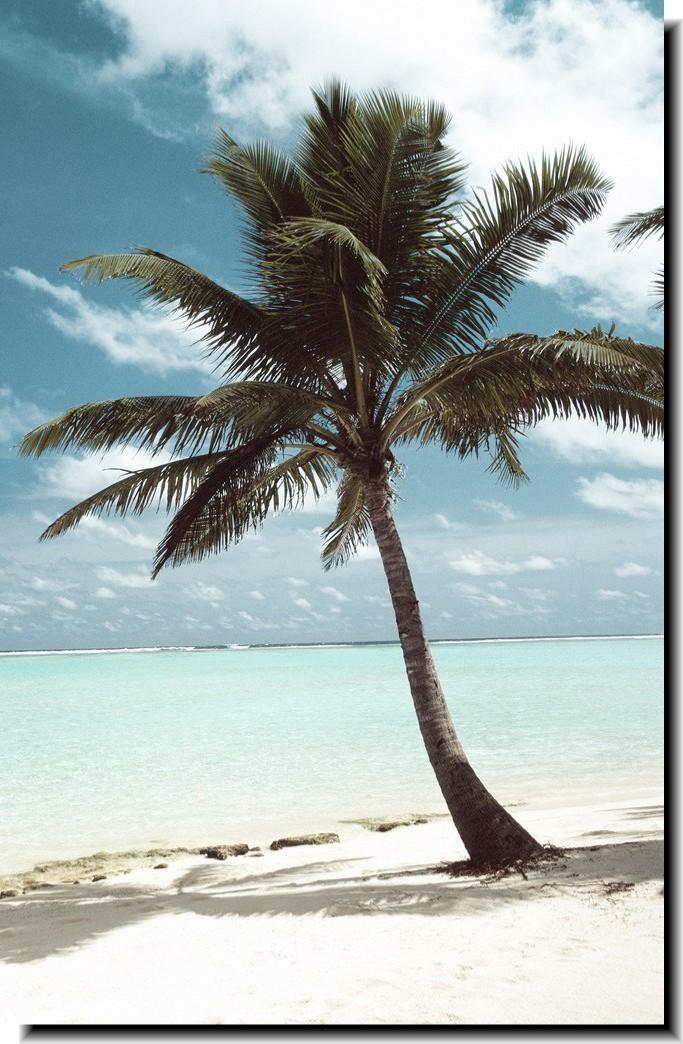
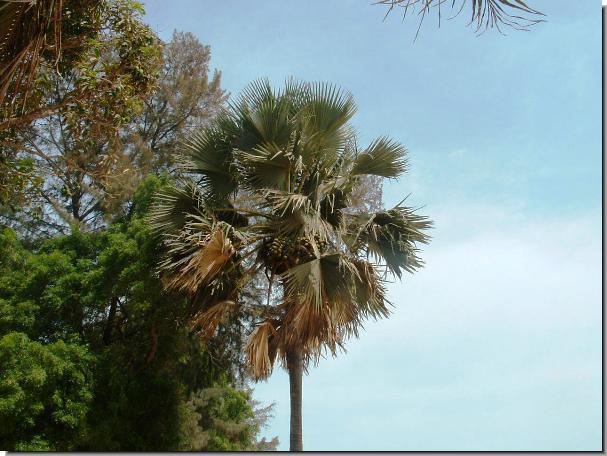
  Coconut palms are sprinkled along the western edge of The Gambia.
If you are adventurous, use a long stick to pull some green coconuts
from a short tree—there are often several branches suitable for
this task in the walled in area between the hotel and the road.
Aim to dislocate the stem from the top of the husk rather than
simply beating it. Once the coconut has fallen, use a machete
to knock off the outer husk.
Coconut palms are sprinkled along the western edge of The Gambia.
If you are adventurous, use a long stick to pull some green coconuts
from a short tree—there are often several branches suitable for
this task in the walled in area between the hotel and the road.
Aim to dislocate the stem from the top of the husk rather than
simply beating it. Once the coconut has fallen, use a machete
to knock off the outer husk.
To get the coconut milk out, use a screwdriver, nail or other
semi-sharp, thin object to poke through one of the three dark
circles at the top of the brown shell. Try all three to see which
is the softest—there will always be one hole that is easiest to
pierce. If you can poke a second hole through one of the harder
circles, the milk will be easier to pour. Once all the milk has
been drained, simply throw the coconut solidly against cement
or rock to break it open. A knife or metal spoon can be used to
separate the white flesh from the hard shell. Don’t worry about
 the
brown skin that will be left on the back—it is entirely edible. the
brown skin that will be left on the back—it is entirely edible.
Species:
Borassus aethiopum Rhun palm/Fan palm/Palmyra palm B. flabellifer
Elaeis guineensis African oil palm
Cocus nucifera Coconut
Raphia vinifera Bamboo palm
Raphia hookeri Raffia palm/Roofmat palm/Wine
palm
Raphia palma-pinus Raffia palm
Raphia sudanica
Calamus deërratus Rattan C. barteri/C. heudelotii
Hyphaene thebaica Doum palm/Gingerbread palm
/Dum palm
I Phoenix dactylifera Date palm
Phoenix reclinata Swamp date palm/Dwarf date
palm/Senegal date palm
Botanic description:
Cocos nucifera trees have a smooth, columnar, light grey-brown
trunk, with a mean diameter of 30-40 cm at breast height, and
topped with a terminal crown of leaves. Tall selections may attain
a height of 24-30 m; dwarf selections also exist. Trunk slender
and slightly swollen at the base, usually erect but may be leaning
or curved. Leaves pinnate, feather shaped, 4-7m long and 1-1.5
m wide at the broadest part. Leaf stalks 1-2 cm in length and
thornless. Inflorescence consists of female and male auxiliary
flowers. Flowers small, light yellow, in clusters that emerge
from canoe-shaped sheaths among the leaves. Male flowers small
and more numerous. Female flowers fewer and occasionally completely
absent; larger, spherical structures, about 25 mm in diameter.
Fruit roughly ovoid, up to 5 cm long and 3 cm wide, composed of
a thick, fibrous husk surrounding a somewhat spherical nut with
a hard, brittle, hairy shell. The nut is 2-2.5 cm in diameter
and 3-4 cm long. Three sunken holes of softer tissue, called ‘eyes’,
are at one end of the nut. Inside the shell is a thin, white,
fleshy layer known as the ‘meat’. The interior of the nut is hollow
but partially filled with a watery liquid called ‘coconut milk’.
The meat is soft and jellylike when immature but becomes firm
with maturity. Coconut milk is abundant in unripe fruit but is
gradually absorbed as ripening proceeds. The fruits are green
at first, turning brownish as they mature; yellow varieties go
from yellow to brown. The generic name seems to be derived from
the Portuguese ‘coco’, meaning ‘monkey’.
The most common type of coconut palm in Gambia is the type belonging
to the Arecaceae (Palmae) family called the Cocos nucifera.
History of cultivation:
Origin of C. nucifera is disputed but evidence favours Southeast
Asia, with subsequent migration east and west, to the Pacific
and Latin America, and to India, Madagascar and East Africa. Coconuts did not reach The Gambia in West Africa until they were taken
there by the Portuguese, around the Cape of Good Hope, after AD
1500.
did not reach The Gambia in West Africa until they were taken
there by the Portuguese, around the Cape of Good Hope, after AD
1500.
Natural Habitat:
C. nucifera is unknown in the wild state. In the coastal areas
of the tropics and subtropics where it is grown, it requires a
hot, moist climate and deep alluvial or loamy soil, thriving especially
near the seaboard, but also considerable distance inland, provided
climatic conditions and soil are suitable. Rocky, laterite or
stagnant soils are unsuitable.
Geographic distribution:
Along the beach areas of Banjul, down south to Kartong as well
as some way inland and past Brikama.
Biophysical limits:
Altitude: 520-900 metres, Mean annual temperature: 20-28 deg.
C, Mean annual rainfall: 1000-1500 mm Soil type: C. nucifera is
tolerant to soil variations but its natural preference is for
sandy, well-aerated and well-drained soils. It has considerable
ability to adapt to soils of heavier texture.
Reproductive Biology:
The tall varieties reproduce by cross-pollination. Male flowers
open first, producing pollen for about 2 weeks. Female flowers
are not usually receptive until about 3 weeks after the opening
of the inflorescence, making cross-pollination the usual pattern.
Wind coming from the Atlantic Ocean is the main pollinating agent.
Reproduction in dwarf varieties is generally through self -pollination.
Female flowers are receptive about a week after the male flowers
open, both ending at about the same time. C. nucifera flowers
approximately after the 6th year.
Propagation methods:
Seed has no dormancy, and growth of embryo and seedling is continuous.
Germination may begin while the fruits are still attached to the
palm tree. Tissue culture is a popular method of vegetative propagation
for producing a large number of progeny. For seed propagation,
nuts are collected from selected mother palms or special seed
gardens.
Products:
Food:
Copra, the dried coconut endosperm, contains an edible cooking
oil (coconut oil). The apical region of C. nucifera is a food
delicacy in areas where it is grown. Other food derivatives of
coconut include coconut chips, coconut jam, coconut honey, coconut
candy and other desserts. Fuel:
The high moisture content of C. nucifera palm wood and the difficulty
of splitting it has made it relatively unpopular as firewood.
Coconut shell charcoal is a minor part of fuel wood. Fibre:
Three types of fibres are obtained from the coconut husks: mat
fibre or yarn fibre, used in making baskets, mats; bristle fibre,
used for brush making; and mattress fibre, used in stuffing mattresses
and in upholstery. Leaflets are used in braiding mats, baskets
and Samakat (cattle herders') hats. Timber:
C. nucifera timber has traditionally been used in Gambia for the
structural framework of houses. Coconut timber taken from the
lower and middle parts of the trunk can be used for load-bearing
structures in buildings, such as frames, floors and trusses. Coconut
trunks can be used for poles, as they have great flexibility and
strength. The wood can also be used for furniture and parquet
flooring when sufficiently polished. Lipids:
The oil contains fatty alcohol and glycerine used in soaps, detergents,
shampoos, pharmaceuticals and cosmetics.. Alcohol:
Sap from the tender, unopened inflorescence (coconut palm tree
sap) is used in the producing areas for an alcoholic beverage
obtained by natural fermentation. This drink contains 6-7.5% alcohol.
The distillation of fermented coconut toddy yields a spirit called
Cana, produced on a small-scale commercial basis in Gambia.
Other products: Coconut-shell
flour, obtained from grinding clean, mature coconut shells to
fine powder, is used as an abrasive for cleaning machinery. Coconut-shell
charcoal may be processed further into activated carbon that has
many industrial applications.
|
|
|
|


 Agriculture Crops
Fruits | Beaches Geography
& Nature
Agriculture Crops
Fruits | Beaches Geography
& Nature