 Information:
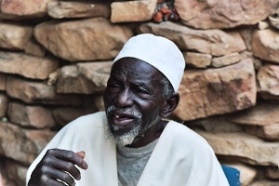 The Gambian chief of a village is called the Alkalo.
He is usually the oldest male of the founding family of the village.
He would then be followed by an assistant who is normally a close
relation to assist him in the administration of village affairs.
One of the central areas of the village is called the Bantaba
where men would sit to make important decisions concerning things
like communal works.
The Gambian chief of a village is called the Alkalo.
He is usually the oldest male of the founding family of the village.
He would then be followed by an assistant who is normally a close
relation to assist him in the administration of village affairs.
One of the central areas of the village is called the Bantaba
where men would sit to make important decisions concerning things
like communal works.
Every village family belongs
to a lineage clan which is called in Mandinka a a Kabillo. The
head of the clan is the oldest male of the related families and
is also known as the Kabillo. The eldest male of the founding
family of the village becomes the village leader or Alkalo. The
Kabillo are responsible to the Alkalo and together with the head
of the local mosque, the Imam, form a so called Council of Elders
which has the function of being the village’s governing body working
alongside the Alkalo. The alkalo’s duties and responsibilities
include tax collection, liaison between the village and local
councils, governmental and non-governmental organisations
and land allocation as well as mediation of disputes at village
level.
The Kafoo is a general term for a social group of people with
common interests, local objectives or professions in the community
that can be single or mixed sex. In most Gambian communities and
in a variety of ways these both provide a dynamic network of kinship
and social organisation in which gender, generation and descent
intersect to shape patterns of development in the traditional/rural
communities. Since colonial times the highest traditional political
structure in The Gambia operating at district level has been the
Chieftaincy. The Chief commands respect, power and authority over
Alkalos in his district. Apart from being the point of contact
for national and local Government, the Chief mediates disputes.
|
|
 |
|


 Culture
& Traditions Family
Structure Funeral
& Burials Greetings Weddings
Culture
& Traditions Family
Structure Funeral
& Burials Greetings Weddings

