Contact Address:
GRTS
Banjul area Headquarters
Serrekunda Exchange Complex
PO Box 387 Banjul
MDI Road, Kanifing, KSMD
The Gambia, West Africa

Email: info@grts.gm
Tel no: +220 4378072
4378125, 4378121
4378090
4375692 (Marketing)
4374242 (Recording studio)
4495 101/4497 419 (Radio)
Fax: +220 4394615 or 449510

|
|
Information:
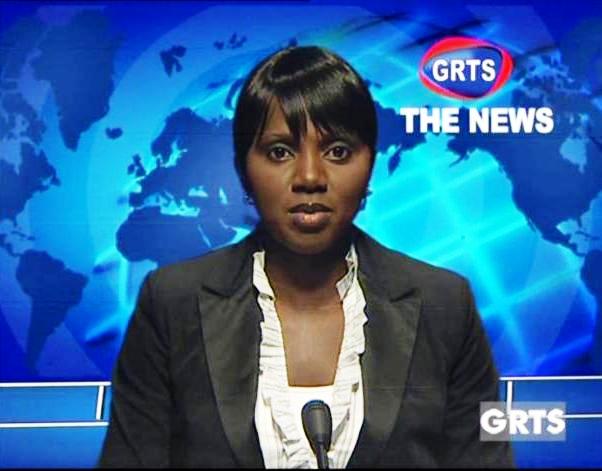
 GRTS is The Gambia's only public service broadcaster. In December
1995 the Government
commissioned the Gambia Radio and Television Service (GRTS)
TV station. Under the umbrella of Gambia Telecommunications
Company (Gamtel) it was to perform
test transmissions from a 5KW transmitter situated at Abuko
covering for the Greater Banjul Area.
GRTS is The Gambia's only public service broadcaster. In December
1995 the Government
commissioned the Gambia Radio and Television Service (GRTS)
TV station. Under the umbrella of Gambia Telecommunications
Company (Gamtel) it was to perform
test transmissions from a 5KW transmitter situated at Abuko
covering for the Greater Banjul Area.
Later, a couple of transmitting stations were erected at the
villages of Bansang and Soma inland to achieve national broadcasting
coverage. Despite these earlier efforts some areas of The
Gambia, in particular the up-river regions still remain outside
the airing range.
Since the moment of its commissioning, GRTS has operated as
a public service station in the tradition of the older established
Radio Gambia. The majority of the programmes are dedicated
to a news, public service announcements,
education, entertainment and religious programmes. Broadcasts
are made in all the 4 main languages as well as English and
French. Some programmes from foreign sources like the BBC
News of the UK, CNN of the USA, Deutsche Welle of Germany
and CFI of France are also regularly shown within the GRTS
station’s programme schedule.
As more and more television units become financially accessible
to local families, GRTS has become an ever more vital and
effective means of communication.
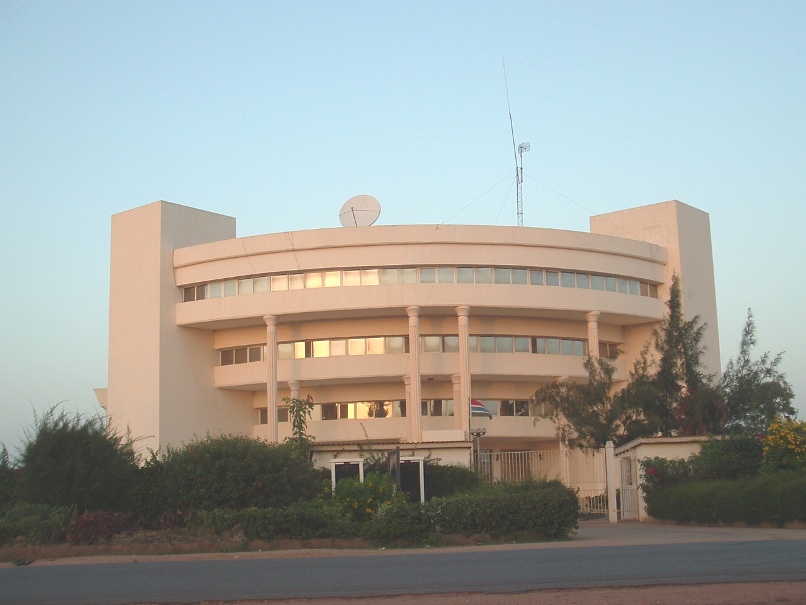
 In
2002 the Government completed building the station's headquarters
to accommodate the GRTS's administrative, technical, and operational
needs. In
2002 the Government completed building the station's headquarters
to accommodate the GRTS's administrative, technical, and operational
needs.
GRTS, Programming & National Development:
The importance of Television broadcasting for socio-economic
development of the Gambia cannot be over emphasised. Knowledge
and information are fundamental drivers of increased productivity
and are seminal to invention, innovation and wealth creation.
GRTS runs programmes on new innovations in appropriate technology
in agriculture as a way of educating our farming communities.
This has tremendous impact on agricultural output of farmers
and has resulted in improved production, especially in rice
and vegetables.
Agriculture being the backbone of the country’s economy, it
is crucial to show programmes that can improve farming methods,
increase yields and ultimately increase food sufficiency and
food security. This in turn is believed to reduce poverty
levels, improves health status of the Gambian people, in line
with the goals and objectives of their Poverty Reduction Strategy.
One of the critical problems facing Gambian society today
is the spread of HIV/AIDS within population. This disease
if not contained or minimised will have a detrimental effect
on The Gambia's socio-economic development as it also affects
the young and most energetic members of the society. With
a series of programmes shown by TV on the AIDS epidemic many
in the society came to grips with realities that the disease
is real and can be avoided.
These and other educational programmes are a very essential
ingredient of poverty reduction strategy and need to be expanded
to cover all areas of the country.
Other GRTS programmes of major importance to poverty reduction
carried by the national TV relates to women and women-related
issues. In the Gambia, women do the majority of the agricultural
production, and programmes that help educate and empower them
are crucial in the drive to gain self-sufficiency in food
production and economic prosperity.
Plans for Future Development:
 It is apparent that if GRTS television is to become a truly
credible national service, it must establish a widespread
presence throughout The Gambia and be more up-to-date with
recent developments in education, agriculture, infrastructural
and health care service provision.
It is apparent that if GRTS television is to become a truly
credible national service, it must establish a widespread
presence throughout The Gambia and be more up-to-date with
recent developments in education, agriculture, infrastructural
and health care service provision.
An essential point in planning ahead is the training of people
and the creation of a second channel for increased viewer
options and spread and to reduce the already congested channel.
A number of GRTS engineers and producers have had the benefit
of international training and awareness, while some organisations
have also operated training courses in Gambia in an attempt
to reach as many trainees as possible.
 |