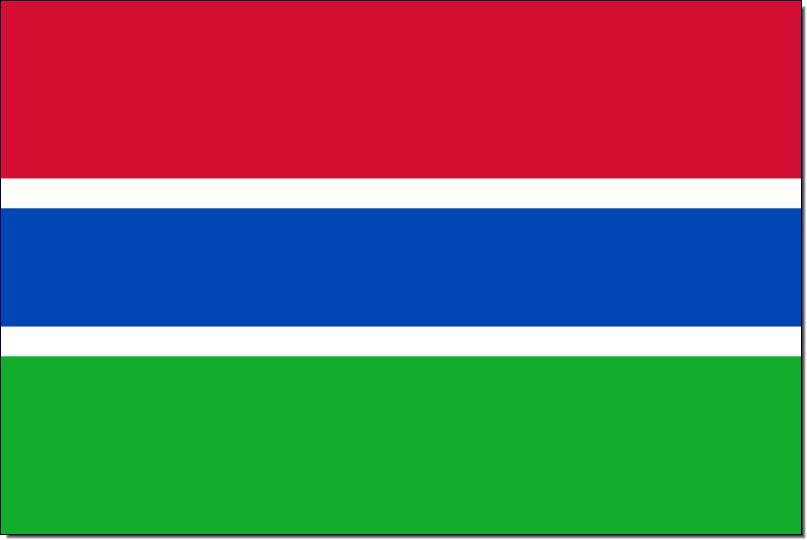
Date:  18th February (1965)
|
 Introduction:
 Independence
Day celebrations are held on the 18th
February of each year which marks the day when Gambia
gained full independence from colonial Britain in 1965.
It is normally celebrated in Banjul
at McCarthy Square with a march pass by school children, civil
servants, the army, teachers and others in front of the President
and other dignitaries. Independence
Day celebrations are held on the 18th
February of each year which marks the day when Gambia
gained full independence from colonial Britain in 1965.
It is normally celebrated in Banjul
at McCarthy Square with a march pass by school children, civil
servants, the army, teachers and others in front of the President
and other dignitaries.
Background:
The country had gained internal self-government earlier in 1963.
The Gambia Independence Act 1964 (1964 c. 93) was an Act of Parliament
in the United Kingdom. It came into operation on December 17,
1964.
The Act made provisions for the Gambia to gain full independence
and become a member of the Commonwealth of Nations; prior to this,
it had been a fully self-governing crown colony.
"1.
Fully responsible status of The Gambia.— (1)
On and after 18th February, 1965 (in this Act referred to as
"the appointed day") all those territories which immediately
before the appointed day are comprised either in the Colony
of the Gambia or in the Protectorate of the Gambia shall together
form part of Her Majesty’s dominions under the name of The Gambia;
and on and after that day Her Majesty’s Government in the United
Kingdom shall have no responsibility for the government
of those territories."
"1965: Countdown to Gambian independence -
The Duke and Duchess of Kent have celebrated the end of 300
years of colonial rule in Gambia with 35 chiefs. At midnight
Gambia will become the smallest - and 37th - sovereign state
in Africa and the last of Britain's West African colonies to
gain independence.
It was the first African nation conquered by the British and
will become the 21st member of the Commonwealth, as well as
the 116th member of the United
Nations.
Representing the Queen, the royal couple was escorted to the
mansa bengo - gathering of kings - by Gambian Prime Minister
Dawda Jawara and Governor Sir John Paul.
All the Gambian leaders showed their respect by removing their
shoes before greeting the British dignitaries.
The oldest chief, Toure Sagniang, said: "It gives us confidence
to know that as a monarchy we are members of that family of
which the Queen is head."
And he thanked the UK for its assistance in making the transition
to independence.
The traditional ceremony - in the village of Brikama, 22 miles
from the capital, Bathurst - included soothsayers and standard
bearers, accompanied by drumming and string instruments.
Guests from around 30 nations were present, including the US
Assistant Secretary of State for African Affairs, George Mennen,
and the Soviet Ambassador to Sierra Leone, Grigori Pashchenko.
Flag up -
The major celebration will begin tonight when the Union Jack
is lowered for the last time and replaced with the red, white,
blue and green of the Gambian national flag.
Presentations from the Gambian and British delegations will
complete the formal beginning of independence.
The British Government has promised to provide support for Gambia,
valued at £3m for the next two-and-a-half years".
In 1965 the Gambia had a total population
of 320,000.
|
|
 |
|



 Culture & Traditions National
Holidays Religious
Festivals
Culture & Traditions National
Holidays Religious
Festivals