Contact Address Details:
United
Nations
Banjul Headquarters Office Address
UN House
5 Kofi Annan Street
Cape Point, P.O. Box 553, Banjul
The Gambia, West Africa
(Office of The Resident Coordinator)
Telephone number: +220 4494760
Fax:
+220 4494758
Telex:
223 UNDP GV
Email: rco.gm@one.un.org
Note:
 The UN mission is the United Nations' official diplomatic
corps' permanent mission representative body in
Gambia.
The UN mission is the United Nations' official diplomatic
corps' permanent mission representative body in
Gambia.
Mission Opening hours:
Monday - Thursday 0800 – 1700
Friday 0800 – 1400
|
|
Information:
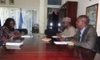 The UN agencies with resident missions in Gambia are following
UN organisations: FAO, UNDP,
UNICEF, WFP,
UNFPA and the WHO.
Two other related institutions that operate under the ambit
of the UNDP are the UNCDF and UNV. UNHCR
also maintain a small staff here to facilitate the authentication
of refugees. The UN system in The Gambia is committed to promoting,
supporting and participating in activities aimed at empowering
the Gambians to develop their physical, human, natural and
social capital for the achievement of sustainable human development.
The UN agencies with resident missions in Gambia are following
UN organisations: FAO, UNDP,
UNICEF, WFP,
UNFPA and the WHO.
Two other related institutions that operate under the ambit
of the UNDP are the UNCDF and UNV. UNHCR
also maintain a small staff here to facilitate the authentication
of refugees. The UN system in The Gambia is committed to promoting,
supporting and participating in activities aimed at empowering
the Gambians to develop their physical, human, natural and
social capital for the achievement of sustainable human development.


(In line with the Government’s development priorities, as
spelled out in the Vision 2020 document, we endeavour to assist
the Gambia adapt to regional and global trends and developments
such as globalisation, regional integration and liberalisation
with a view to integrating the Gambian economy into the global
market in such a way that the benefits of globalisation, liberalisation
and regional integration are optimised while simultaneously
mitigating their negative impact on the most vulnerable segments
of the society, particularly women and children. In this respect,
we will assist the Government in instituting “social safety
nets”, formulate “social policies in globalisation” and forge
strategic alliances for facilitating “development with a human
face”. ) - source UN.
Historical Background:
The Gambia joined the United Nations in 21 September, 1965
along with Maldives and Singapore that same year. The country
was elected into the membership of the Security Council for
the first time as a non-permanent member in 1998 through to
1999.
Data Issues:
The lack of accurate and timely data is a major constraint
to improved macro-economic and financial management. In this
respect, the UN system together with other development partners,
particularly the Bretton Woods institutions, are assisting
the government to build capacities in data gathering and analysis,
within the context of the Poverty Reduction Strategy Paper
(PRSP), including providing assistance to the Central Statistics
Department in the areas of national accounts and the consumer
price index as well as undertaking Public Expenditure Reviews
in some of the key Departments Of State (Education, Health,
Public Works, Local Government, etc.). Other developments
on the economic plane include the introduction of the Poverty
Reduction Strategy Paper, the United Nations Development Assistance
Framework (UNDAF), and the eligibility of the Gambia under
the Heavily Indebted Poor Countries (HIPC) Initiative.

|