Introduction:
 The
tama drum is nearly as common as the sabar and is played by a
larger number of ethnic groups
than the sabar, including the Wolof,
Serer, Fulbe, Tukuloor, Malinke, and Mandinko. Similar instruments
are found throughout West Africa. The
tama drum is nearly as common as the sabar and is played by a
larger number of ethnic groups
than the sabar, including the Wolof,
Serer, Fulbe, Tukuloor, Malinke, and Mandinko. Similar instruments
are found throughout West Africa.
Playing Methods, Performance & Context:
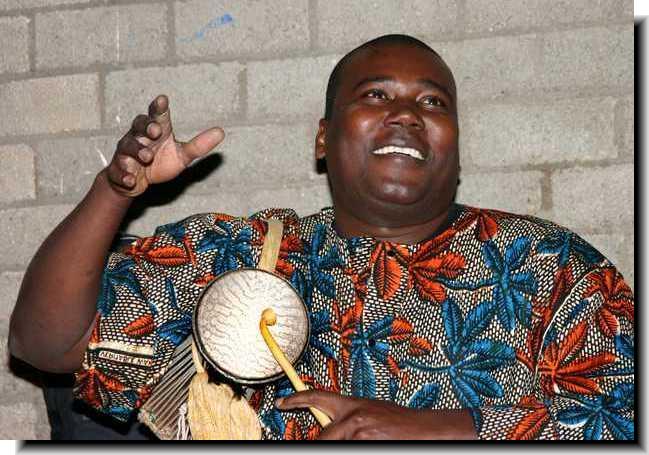
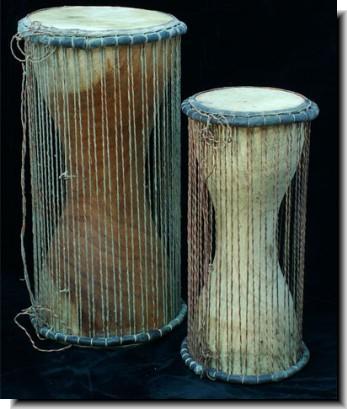
The tama is a 'talking drum,' or a drum whose pitch can be regulated.
The player puts the tama under one shoulder and beats the tama
with a curved stick held in the other hand. To regulate the pitch,
the player squeezes the strings that surround the tama with his
arm, tightening the drum head and thereby raising the pitch. Because
it can imitate the inflections of the human voice, certain patterns
have literal verbal meanings, although to most Gambians today,
the tama is simply an instrument used to accompany dance and concert
music.
Traditionally, the tama was a court instrument, used by kings
and chiefs to summon people. Although most tama are very small,
with a diameter of about 4 to 5 inches, the royal tama, which
are extremely rare now, were almost twice as large. Tamas are
used primarily to accompany dancing
or griots' chants. The Wolof in
most areas have little tradition of melodic singing, and griots'
"praise singing" is often actually rhythmic chanting
to a percussive accompaniment, much like rapping.
The tama is an important part of almost all modern mballax
groups. Although it is not quite as indispensable as the sabar,
it adds a flavour that most groups consider to be an integral
part of their music. Assane Thiam, the tama player of Senegambia's
most famous singer, Youssou Ndour, has made a solo career recording
somewhat traditional Wolof rhythmic chants.
|
|
|
|


 Culture & Traditions Music Traditional Modern
Senegambian Music
Culture & Traditions Music Traditional Modern
Senegambian Music