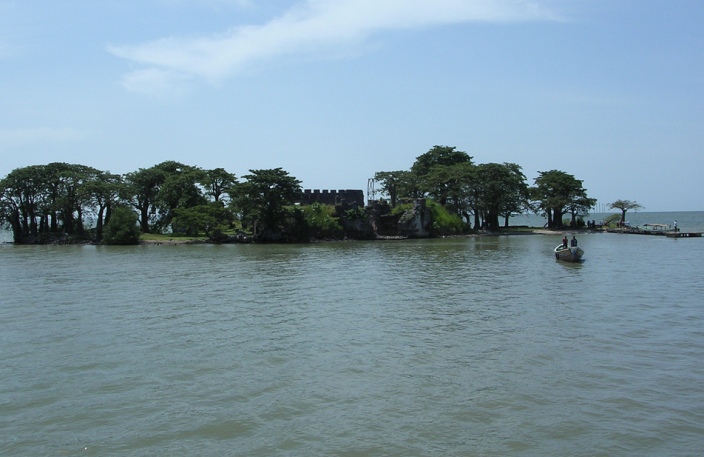
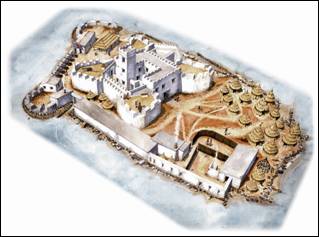
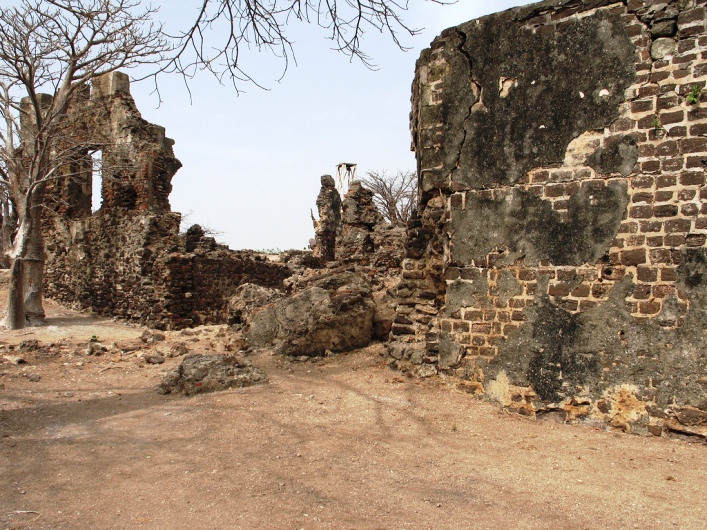
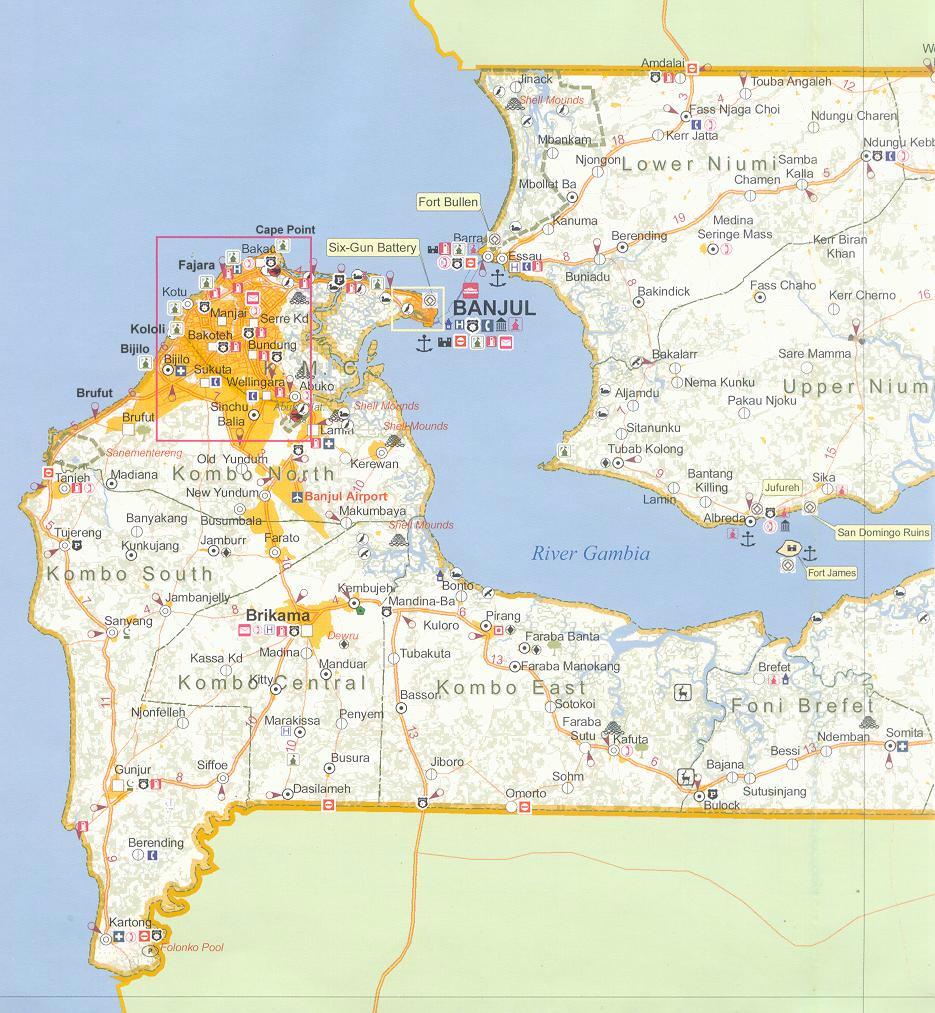
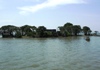
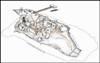
The old Fort of James Island (re-named Kunta Kinteh Island in Gambia) is located about 30 km upstream on the river
(see map) and is home
to the ruins which once belonged to colonial
Britain. This was the last bit of African soil that many slaves
saw before being transported in the bowels of transatlantic slave
ships to the Americas.
in Gambia) is located about 30 km upstream on the river
(see map) and is home
to the ruins which once belonged to colonial
Britain. This was the last bit of African soil that many slaves
saw before being transported in the bowels of transatlantic slave
ships to the Americas.
 The area was 'discovered' in 1456 by the Portuguese navigators
Antoniotti Usodimare and Captains Luiz de Cadamosto on their second
expedition up the river Gambia. They called it St. Andrews Island
supposedly after a sailor who had died and was buried there. The
name was changed by later European colonialist. It was purchased
by the Duke of Courland 200 years later after which the Baltic
Germans began building the fortifications in 1651 so it could
be used as a trading post between Latvia, Lithuania and the local
Africans.
The area was 'discovered' in 1456 by the Portuguese navigators
Antoniotti Usodimare and Captains Luiz de Cadamosto on their second
expedition up the river Gambia. They called it St. Andrews Island
supposedly after a sailor who had died and was buried there. The
name was changed by later European colonialist. It was purchased
by the Duke of Courland 200 years later after which the Baltic
Germans began building the fortifications in 1651 so it could
be used as a trading post between Latvia, Lithuania and the local
Africans.
It was seized by the British 10 years later in 1661 under the
hands of the Royal Adventurers Of England Trading Into Africa,
who received a Royal Patent from Charles II to buy ivory, gold
and other commodities as well as slaves. They renamed the island
James Island after the heir to the throne who was to become King
James III [1].
 The
significance of this take-over was James Island represented Britain's
first outpost in West Africa [2]. The island subsequently changed
hands many times over the next two centuries particularly between
the French and British. The
significance of this take-over was James Island represented Britain's
first outpost in West Africa [2]. The island subsequently changed
hands many times over the next two centuries particularly between
the French and British.
In 1779 French troops based at the slave post of Albreda, near
Juffure,
were ordered to deal with the British once-and-for-all and they
were duly ejected for the last time from the island and the French
proceeded to destroy it. After the passing of the abolition act
of 1857 the British moved their emphasis to fighting slavery and
chose the forts of Banjul
and Barra
to achieve this. By 1830's the island was abandoned for good.
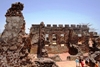
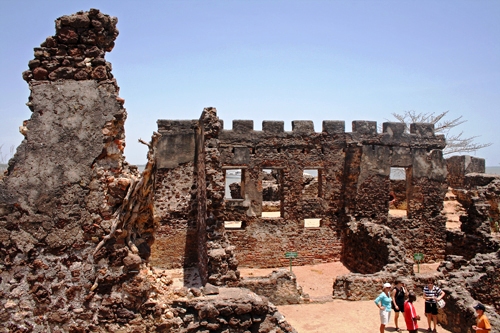
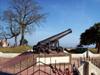
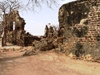
Today, on a visit to the island, the ruins of colonialism and
slavery can still be seen. There are caves and prisons on the
island where slaves
were imprisoned before being shipped off to the American colonies.
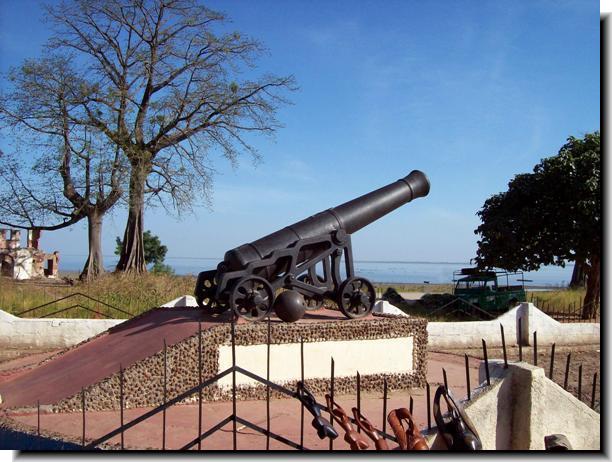
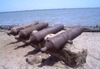
There are also some cannons standing in their military attack
positions.
The island sadly is shrinking due to coastal erosion and has reduced
in size to a great extent compared to its heyday as a slave collection
point and trading post.
 Travel Information
A trip to Kunta Kinteh Island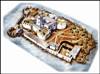 [James Island] is usually done as part of a 'roots tour' which
also includes the nearby villages of Juffure
and Albreda as well as to the museum. It can be reached by taking
a ferry
from Banjul
to Barra
on the north bank of the river.
From there a taxi
or other vehicle would take you by road to Juffureh. Accommodation
available are the Kunta Kinte Roots Camp or the Juffure Guest
House. There is a restaurant
called the Rising Sun Restaurant there.
[James Island] is usually done as part of a 'roots tour' which
also includes the nearby villages of Juffure
and Albreda as well as to the museum. It can be reached by taking
a ferry
from Banjul
to Barra
on the north bank of the river.
From there a taxi
or other vehicle would take you by road to Juffureh. Accommodation
available are the Kunta Kinte Roots Camp or the Juffure Guest
House. There is a restaurant
called the Rising Sun Restaurant there.
The other route is to take a Roots cruise by boat upriver directly
to the island. These boats are run by local operators based at
Denton
Bridge.
Nearest Accommodation:

References:
[1] Gambia - Michael Tomkinson
[2] Encyclopaedia Britannica 2014
|
|
 Attractions

Nature
Reserves
Resorts
 Bakau Bakau
Banjul
Bijilo
Brufut
Cape
Point
Fajara
Gunjur
Jinack
Island
Kartong
Kololi
Kotu
Makasutu
Sanyang
Serrekunda
Tanji Village

|